


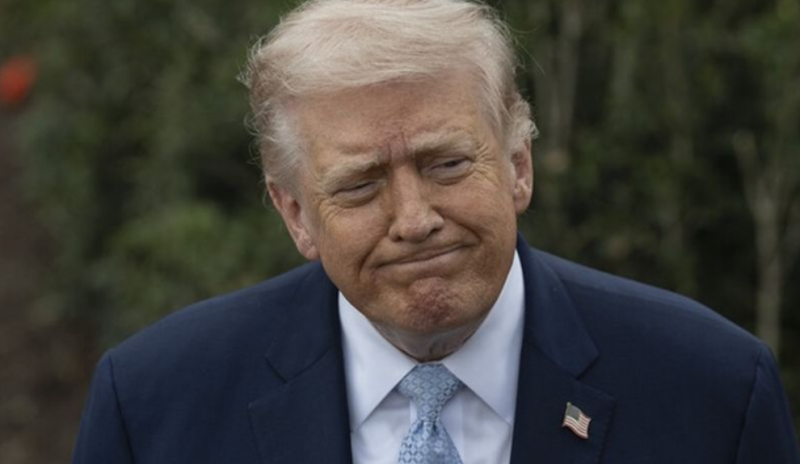
U.S. President Donald Trump has issued an order for a trade ban against Spain, instructing Treasury Secretary Scott Bisent to "cut all trade relations... including visits" amidst tensions over defense spending.
A U.S. official revealed to Reuters on Wednesday that the Departments of Treasury and Commerce, along with the U.S. Trade Representative, will provide President Trump with "a list of Spanish products that could be banned in the coming days." This suggests that the trade ban could be partial.
Here's a look at Trump's potential options to halt trade with Spain and the implications of such a move.
What powers does the U.S. President have to impose a trade ban?
Trade law experts state that the International Emergency Economic Powers Act still allows President Trump to impose trade bans or economic sanctions, despite a U.S. Supreme Court ruling in February against using it to impose tariffs.
To activate the law, Trump would need to declare a national emergency due to "an unusual or extraordinary threat" to U.S. national security, foreign policy, or economy.
The law has been widely used to restrict trade with Iran, Russia, and North Korea and to prohibit dollar transactions with companies and individuals linked to terrorism or national security threats.
Peter Shane, a law professor at New York University, said it's "hard to imagine" how a NATO country's failure to meet a defense spending goal by 3% of GDP in peacetime could constitute a national emergency for the U.S.
However, former Senate Finance Committee trade advisor Mayur Patel states that the Supreme Court has not expressed an opinion on the nature of the emergencies cited by Trump for tariffs, indicating his ability to declare a national emergency remains "unscathed."
"The International Emergency Economic Powers Act would permit Trump to impose a trade ban," added Patel, now a trade expert at Hogan Lovells law firm in Washington, even if it's later challenged legally.
What volume of trade would be impacted by the ban?
U.S. Census Bureau data shows total goods trade between the U.S. and Spain was $47.9 billion in 2025. When including services trade, such as travel, the total trade volume rises to $74.5 billion, placing Spain as the 23rd largest U.S. trading partner.
The U.S. exports more to Spain than it imports, with U.S. exports at $26.6 billion in 2025, versus imports of $21.35 billion, resulting in a trade surplus of $5.25 billion.
Notable U.S. imports from Spain include pharmaceuticals, electric transformers, energy products, personal care items, and glazed ceramics. Major U.S. exports to Spain include pharmaceuticals, crude oil, civil aircraft, and corn.
A trade ban could disrupt bilateral investments. Eurostat data, cited by the American Chamber of Commerce in Spain, indicates Spanish companies invest €97.2 billion ($111 billion) in the U.S., their largest investment destination worldwide.
The U.S. is the largest foreign investor in Spain, with over €116 billion ($132.4 billion) in capital investments, supporting around 200,000 Spanish jobs.
What is the future of travel between Spain and the U.S.?
It's unclear how Trump will impose travel restrictions on Spaniards while the Spanish national soccer team prepares for a World Cup match in the U.S. on Friday. However, last year, the U.S. barred people from over 30 countries, including tourists, students, and businessmen, over security concerns.
Trump also hasn't clarified if the travel ban will apply to U.S. visitors to Spain, whose spending there counts as service imports to the U.S.
Spain's National Statistics Institute (INE) noted that approximately 4.45 million Americans visited Spain for more than a day in 2025, a 4.3% increase from 2024. Americans comprised 4.6% of Spain's 96.8 million total visitors in 2026, ranking sixth after the UK, France, Germany, Italy, and the Netherlands.
Spanish Central Bank data shows U.S. travelers accounted for the fourth-largest tourism revenue source for Spain, generating €6.15 billion in 2024. The bank noted Americans tend to stay longer and spend more per trip compared to other nationalities.
What alternatives are there besides a full ban?
Patel stated Trump could impose a selective ban under the International Emergency Economic Powers Act, similar to actions by him and President Biden against Russia, allowing essential goods to continue. For Russia, these items included enriched uranium, fertilizers, and palladium.
Trump previously exempted aircraft parts from tariffs, so components from Spanish firm ITP Aero used by General Electric, RTX, and Pratt & Whitney might be spared.
Trump also has tools to impose tariffs or other trade measures, including Section 301 of the Trade Act of 1974, used for unfair trade practices, including forced labor, affecting 60 trade partners, including the EU.
Additionally, Trump could employ a Cold-War-era trade law, Section 232 of the 1962 Trade Expansion Act, which protects industries like automobiles, steel, and aluminum critical for national security.
Complicating any potential trade action against Spain is that the EU sets trade policies for its members, requiring uniform treatment across the bloc. However, the U.S. has previously threatened EU countries with tariffs on digital services.
The U.S. Commerce Department could also target Spanish imports with anti-dumping and countervailing duty investigations. During Trump's first term, in response to California olive producers' requests, a 30% anti-dumping duty was imposed on Spanish black olives under the 1930 Tariff Act.
Has Trump previously threatened Spain?
Yes. Trump first threatened tariffs on Spain in October 2025, suggesting potential penalties due to Spain's refusal at a NATO summit in The Hague four months earlier to raise defense spending to 5% of GDP.
In March this year, Trump also instructed Bisent and U.S. Trade Representative Jamieson Greer to investigate banning all Spanish goods. To date, no such investigations have been announced in the Federal Register.
What is Spain's contribution to NATO?
The latest NATO estimates project Spain's basic defense spending to reach €35.41 billion ($40.4 billion) in 2026, about 2% of GDP, compared to €11.17 billion ($12.8 billion) when Prime Minister Pedro Sánchez took office in 2018.
Spanish government officials, citing NATO data, noted Spain ranked seventh in absolute defense spending in 2025. Since 2022, Spain has provided €3.795 billion in support for Ukraine.