


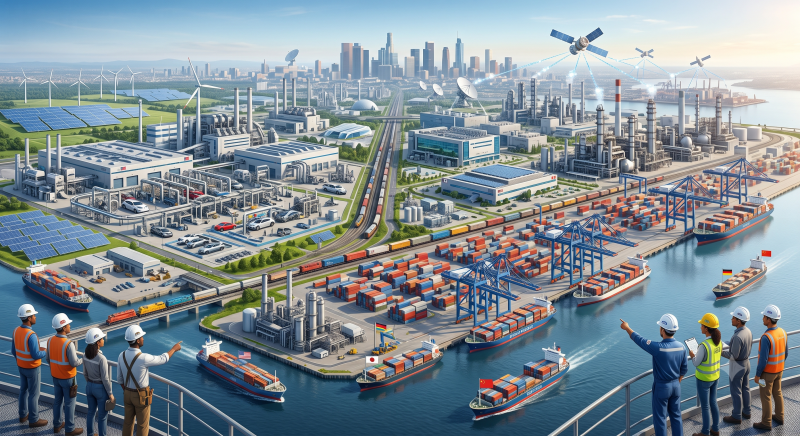
Industry has long been a cornerstone of major economies, offering more than just goods and product manufacturing, but also intertwining with technology, innovation, global trade, and economic security.
Nations with robust industrial sectors can build more competitive economies, generate widespread employment, and exert significant influence over international markets.
In the past decades, several countries have emerged as industrial powerhouses, becoming central to global production.
While traditional leaders like the United States, Germany, and Japan have maintained their historical standing, China, India, and South Korea are rising as new industrial giants, reshaping the global manufacturing landscape.
List of Major Industrial Nations in the World:

China: The World's Factory and Leading Manufacturing Giant
China tops the list of the world's largest industrial countries, often referred to as "the world's factory" due to its massive production scale and diverse industrial sectors.
In a relatively short time, China built an expansive network of factories and supply chains across various fields, from consumer goods to advanced technology industries.
Chinese industry excels in producing electronics, smartphones, automobiles, industrial machinery, and heavy equipment, while also being a pivotal player in emerging fields such as electric vehicles and renewable energy.
United States: Industrial Power Rooted in Innovation
The United States stands as one of the world's industrial giants, with a sophisticated sector that combines mass production with advanced technology.
Despite substantial growth in services, industry remains a critical component of the U.S. economy.
The U.S. is prominent in aerospace, automotive, pharmaceuticals, electronics, military equipment, and energy industries. It benefits from global corporations and advanced research centers that drive industrial technological breakthroughs.
Germany: The Heart of European Industry
Germany is the largest industrial power in Europe, globally known for product quality and engineering precision, primarily relying on manufacturing, especially in automotive, machinery, and chemical industries.
German industry is characterized by high-tech reliance, technical skills, and a strong focus on research and development. German products' reputation for quality and efficiency boosts global demand, particularly in automotive and mechanical engineering sectors.
Japan: Leader in Technology and Precision Industries
Japan, one of the oldest modern industrial powers, has built an industrial model emphasizing quality, innovation, and precision. Despite limited natural resources, Japan developed global industries placing it among the top industrial economies.
Japan is renowned for automobiles, electronics, robotics, and precision machinery. It leads in automation and technology use within factories, prompted by continuous investment in education and scientific research to maintain its industrial status.

India: The Emerging Industrial Giant
India experienced significant industrial growth recently, aiming to strengthen its role as a global manufacturing hub with its large market and workforce attracting substantial international industrial investments.
Indian industry shines in pharmaceuticals, automotive, electronics, textiles, and information technology, with government efforts to attract global companies and enhance industrial infrastructure to increase global production share.
South Korea: Powerhouse of Electronics and Semiconductors
South Korea transformed from a small economy to a leading industrial power in decades, relying on technology and substantial investment in education, research, and development.
South Korea leads in electronics, semiconductors, automotive, and shipbuilding, hosting influential global tech companies and focusing on innovation, essential for future industries.
Italy: Industry Built on Quality and Design
Italy possesses a diverse industrial base combining technology, craftsmanship, and design, granting its products a unique global market position. It is notably recognized for luxury automobiles, fashion, machinery, and food products.
Despite its economy's size relative to major industrial powers, Italy maintains a robust presence by focusing on high-value, high-quality industries.
France: Advanced Industries, Aviation, and Energy
France is a key European industrial nation with vast experience in advanced sectors, excelling in aircraft, energy, automotive, pharmaceuticals, and food industries.
It relies on innovation and technology to maintain industrial competitiveness, hosting major international companies and research infrastructure that innovate new products and technologies.
United Kingdom: Advanced Industry Amid Economic Shifts
Despite significant economic shifts towards services, the UK retains important industries, especially in aerospace, pharmaceuticals, engineering, and technology.
The UK benefits from historical industrial expertise, alongside universities, research centers, and global companies that drive innovation and development across modern industrial fields.
Canada: Resource and Technology-based Industry
Canada's robust industrial sector relies on diverse natural resources and technological capabilities, excelling in energy, mining, automotive, aerospace, and food industries.
Geographical location and major market trade relations have helped Canada develop a competitive industrial sector, especially in resource and energy-related industries.
What Makes a Country a Major Industrial Power?
An industrial powerhouse is determined by factors beyond the number of factories, including:
- Investment in technology and innovation.
- Availability of transportation and energy infrastructure.
- Presence of skilled and trained workforce.
- Support for research and development.
- Export capacity and global market access.
- Presence of large industrial companies.
See Also: