


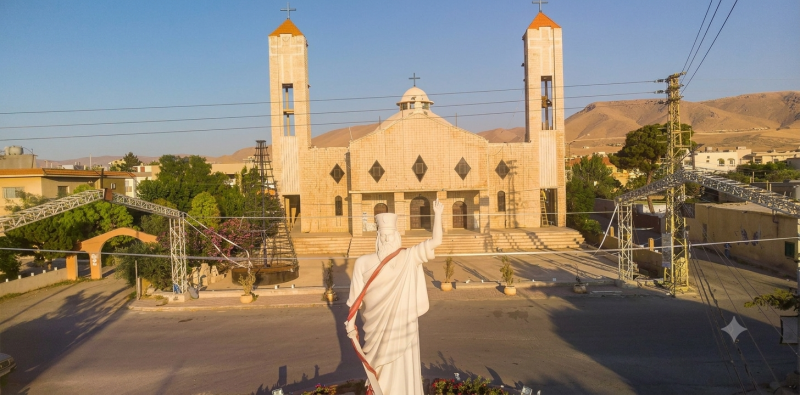
Lebanon boasts a rich array of religious landmarks showcasing its historical and cultural diversity. From ancient churches and monasteries dotting the coastal cities, mountains, and valleys, these sites offer more than just religious significance. They form an integral part of Lebanon's architectural and cultural memory.
Moreover, several Lebanese churches are located in breathtaking natural settings, such as monasteries perched over valleys or overlooking the sea, while others within city bounds retain historical and artistic value.
Top 10 Churches in Lebanon
1. Our Lady of Lebanon Shrine – Harissa
The Our Lady of Lebanon Shrine in Harissa is among Lebanon's most renowned religious and tourist sites. Situated on a hill with a stunning view of the Bay of Jounieh and the Mediterranean Sea, the site features a colossal statue of the Virgin Mary, becoming one of Lebanon's visual symbols.
Harissa's significance extends beyond the statue, as it is home to the Basilica of Our Lady of Lebanon, welcoming visitors and worshippers from various regions. Its elevated location provides panoramic views of the Lebanese coast, making it both a religious and tourist destination.
2. St. George Maronite Cathedral – Beirut
The St. George Maronite Cathedral resides in the heart of Beirut, near the Nejmeh Square and Mohamed Al-Amin Mosque. Known for its classical architectural design inspired by European churches, the cathedral is a prominent religious landmark in central Beirut, its history tied to the city's development in the 19th and 20th centuries.
Heavily damaged during the Lebanese Civil War, it has since undergone restoration to recapture much of its former glory. Proximity to several historical landmarks in downtown Beirut allows visitors to blend their visit with a cultural tour of the capital's core.
3. St. Nicholas Greek Orthodox Cathedral – Beirut
Located in Ashrafieh and known as St. Nicholas Greek Orthodox Cathedral, this church stands out as one of the foremost Orthodox churches in Lebanon's capital.
The cathedral holds particular significance due to its history and association with Beirut's Orthodox heritage, decorated with icons and religious art reflecting Byzantine church traditions.
Its location near various cultural and artistic sites in Ashrafieh also makes it a pivotal stop for those interested in exploring the historical and religious facets of the city.
4. St. Louis Cathedral for the Capuchin Fathers – Beirut
Positioned in central Beirut, the St. Louis Cathedral for the Capuchin Fathers is a historic church linked to the presence of Capuchin monks in the capital. The church's architecture is influenced by European styles, with distinctive interior details that convey its unique artistic identity.
Its presence in the city center marks an important phase in Beirut's history and development of religious and cultural institutions. Its closeness to numerous historical sites in the capital makes it a fitting segment of a tour exploring both old and new Beirut.
5. Monastery of Saint Qozhaya – Qadisha Valley
The Monastery of Saint Qozhaya stands out as a prominent historic monastic site in the Qadisha Valley, also known as the Holy Valley. Nestled within a unique mountain setting among rocks and forests, the monastery has a long history of Maronite monastic life, with caves and structures reflecting centuries of religious life in the valley.
A notable aspect of the monastery's history includes an ancient press dating back to the 16th century, tied to the printing history in Syriac and Arabic in the area. Thus, visiting the monastery offers insights not only into spiritual life but also into early book and printing history in Lebanon.
6. Our Lady of Qannoubine Monastery – Qadisha Valley
Lodged deep within the Qadisha Valley, the Our Lady of Qannoubine Monastery is regarded as a pivotal religious and historical site in the sacred valley. Historically linked to the Maronite Patriarchate, it served as the Patriarchate's seat for many centuries.
Its mountainous nature grants it extraordinary standing, with the monastery's construction on steep rocky terrain reflecting the monastic lifestyle's essence that emerged in the Qadisha Valley. The Qadisha Valley and Cedars of God are inscribed as UNESCO World Heritage Sites, enhancing the area's cultural significance.
7. Monastery of Saint Maron – Hermel
Near the Orontes River in Hermel lies the Monastery of Saint Maron, a notable religious and historic site in northern Bekaa. The site is distinguished by its rocky formations and caves connected to Christian and monastic traditions in the region.
The natural rocks surrounding the monastery provide a unique setting, distinct from traditional city churches, with its location near the Orontes River offering a landscape marrying religious heritage and mountain scenery.
8. Monastery of Our Lady of Balamand – Koura
Located in Koura, Northern Lebanon, the Monastery of Our Lady of Balamand stands as a preeminent historical Orthodox monastery. Linked to the Crusader era, it has evolved into a key center for Orthodox monastic life.
Renowned for its architecture and tranquil setting, it’s associated with Orthodox education and culture in Lebanon and the region. Its proximity to Balamand University makes it a hub blending religious heritage, education, and culture in North Lebanon.
9. Our Lady of Nourieh Monastery – Hamat
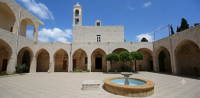
Perched on a high rocky cliff in Hamat, overlooking the Mediterranean Sea, the Our Lady of Nourieh Monastery is one of Lebanon's most naturally scenic monasteries. The surrounding rocky cliffs and sea create an extraordinary scene, with its tranquil nature enhancing its spiritual draw for visitors and pilgrims.
The area around the monastery suits nature and photography enthusiasts, blending coastal vistas, rocky formations, and religious sites.
10. St. John Mark Church – Byblos
Sited in Byblos near the ancient castle and archaeological sites, St. John Mark Church is a significant historical church in the city. Its history is intertwined with the Crusader era, while its design showcases the architectural influences throughout the Middle Ages.
Being near the ancient ruins of Byblos integrates it into the diverse historical tapestry of the city, which is one of the oldest continually inhabited cities globally, offering a chance to combine religious tourism with exploring the Phoenician, Roman, and Crusader legacies.
Why Lebanese Churches and Monasteries are Unique
The significance of Lebanese churches extends beyond their age to the vast diversity they embody, from cathedrals in city centers like Beirut to secluded mountain monasteries like those in Qadisha Valley, and shrines overlooking the sea like Harissa and Hamat.
This diversity mirrors different phases of Lebanon's history, from early Christian traditions to medieval times and modern architecture, turning some sites into places combining worship with cultural and heritage tourism.
Best Areas to Explore Historic Churches in Lebanon
For those aiming to uncover numerous religious landmarks during a single trip, Beirut, Qadisha Valley, Byblos, and North Lebanon offer a wide array of options.
In Beirut, visitors can combine visits to historic cathedrals with city tours in old neighborhoods, while Qadisha Valley offers a unique journey through its mountain nature and rock-carved monasteries.
In contrast, areas like Byblos, Hamat, and Harissa provide experiences combining religious sites, natural vistas, and ancient ruins, perfect for cultural and tourism trips throughout the year.
In conclusion, the top 10 churches in Lebanon represent an essential facet of the nation's religious and architectural heritage, spanning historical cathedrals in Beirut, ancient mountain monasteries, and scenic sea-view shrines.
Visiting these historical churches and monasteries blends spirituality with history and nature, offering visitors insights into a distinctive aspect of Lebanese identity.
See also
Top 10 Affordable Tourist Destinations