


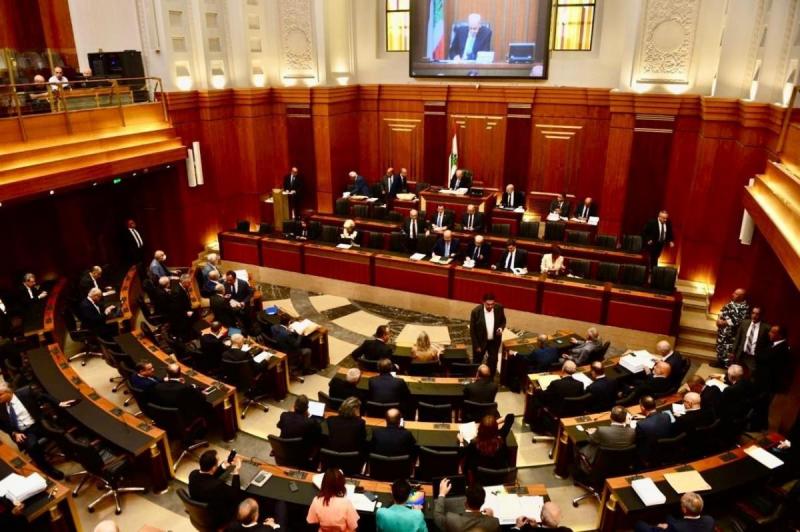
The recent legislative sessions held by the Lebanese Parliament on Tuesday and Wednesday have reshaped the political alliances within the Parliament, bringing to the fore some old and new intersections.
Amid laws on the abolition of the death penalty, general amnesty, and amendments to banking sector reforms, both Hezbollah and the Free Patriotic Movement (FPM) found common ground in opposing the death penalty and general amnesty laws. They also jointly stood against Prime Minister Nawaf Salam following a dispute involving Defense Minister Michel Manzi.
On Tuesday, while most parliamentary blocs endorsed the law abolishing the death penalty, Hezbollah and the FPM opposed it.
The following day, Wednesday, saw the approval of the general amnesty law, but only after members of both blocs withdrew in protest, claiming that the Defense Minister was barred from addressing the assembly regarding the law. Consequently, Manzi left the Parliament for the second consecutive day.
Joint Campaign Against the Prime Minister
The convergence of Hezbollah and the FPM wasn't just limited to their stance on the legislative content. Their alignment extended into the issue of the Defense Minister's prerogatives, resulting in a joint campaign against the Prime Minister.
Prime Minister Salam, on Tuesday, dismissed claims of barring Minister Manzi's attendance, stating that he intended to speak for the government during the amnesty law discussions, as per Article 64 of the constitution, which designates the Prime Minister as the government's representative and spokesperson.
He affirmed their work under ministerial solidarity, asserting, "We are not 24 governments."
While stressing the government's efforts to support and equip the military, Salam insisted his stance should not be seen as a challenge against any Lebanese faction.
He summed up his position on amnesty with, "Justice, justice, justice," reiterating that the final decision lies with the Parliament.
Despite this, objections persisted. After accusing Salam of constitutional violation by setting a dangerous precedent, FPM leader Gebran Bassil's deputies withdrew from the Wednesday session during amnesty discussions. MP Slim Aoun noted the withdrawal was to avoid recording such a violation.
Similarly, Hezbollah MPs left the session for the same reasons, emphasizing that no one should prevent a minister from voicing their opinion.
However, Hezbollah MPs returned for the session's second half, voting for the "banking law" in contrast to the FPM, who opposed it.
Hayek: No Alliance or Agreement with Hezbollah
Despite the session’s convergence, FPM's Deputy Head Naji Hayek, asserted, "There is no alliance or agreement with Hezbollah," acknowledging occasional overlaps in positions and approaches to certain issues.
He clarified that the FPM's stance was rooted in opposition to releasing army killers, recognizing unfair imprisonment without trials but affirming the army's sacrosanct status.
Hayek also appreciated Salam's efforts in countering Hezbollah, citing him as the only leader currently challenging the party.
Berri, Forces, Kataeb, and Socialists in Different Camps
Contrarily, Speaker Nabih Berri did not side with Hezbollah in this dispute. After a meeting with Salam and the Defense Minister, MTV reported Berri stating, "The Defense Minister's speech is unnecessary."
The Development and Liberation Bloc, alongside the Progressive Socialist Party, Lebanese Forces, and Kataeb Party, supported all three laws. Kataeb leader Sami Gemayel hailed the abolition of the death penalty as a milestone for human rights and dignity, opposing sectarian debates over amnesty.
Lebanese Forces leader Samir Geagea endorsed the abolition and supported the amnesty law, viewing the death penalty's removal as significant for Lebanon's humanitarian image.
Socialist Bloc member MP Bilal Abdullah stated that approving the amnesty law closes a political chapter where a Lebanese faction (hinting at the Sunni community) was targeted by the system, thanking Speaker Berri for fostering consensus with the government and acknowledging the Lebanese Forces and Deputy Speaker Elias Bou Saab's roles.
Lebanon's Legislative Session Realigns Political Blocs: Hezbollah and Free Patriotic Movement Unite
Share