


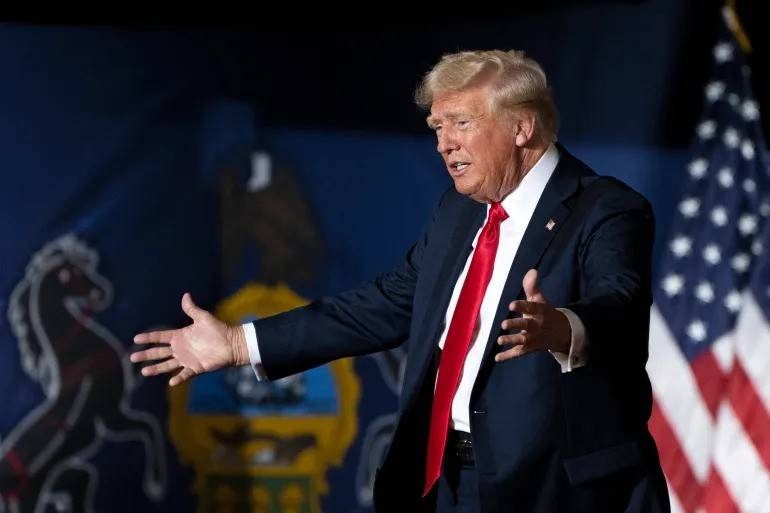
Despite ongoing efforts to reach an agreement between Iran and the United States as the 60-day deadline approaches mid-August, President Trump seems increasingly focused on applying economic pressure on Iran.
A White House official revealed to Bloomberg that "sanctions and the naval blockade have left Tehran completely bankrupt."
Moreover, Trump has several pressure tools he can employ in the coming months, although further details weren't disclosed.
This renewed emphasis on economic damage, an approach known during Trump’s first term as "maximum pressure," marks a notable shift in U.S. administration policy. Just days ago, they considered broadening the military campaign against Tehran, as reported by Bloomberg.
U.S. Ambassador to the United Nations Mike Waltz, speaking to Fox News on August 10, stated that the "economic fury campaign," led by Treasury Secretary Scott Bisent, is wreaking havoc on Iran's economy.
He added that while Iran can withstand bombardment, its citizens are reportedly more afraid of Bisent than Defense Secretary Pete Hegseth.
Trump echoed similar sentiments to Axios last Sunday, noting that he deals with Iran quietly. "We are just watching Iran suffer enormous inflation and the fact that they have no money," he said.
Bisent shared the same view weeks ago in a Fox News interview, asserting that "the government is causing its people to suffer, and we will continue to increase the pressure."
Edge of Economic Collapse
These positions align with analysts who argue that the Iranian regime is nearing economic collapse.
However, this theory is contested by the reality that the U.S. has imposed sanctions on Iran—and several other countries—for decades without significant political changes. Examples include North Korea and Cuba, also recent targets of Trump's policies.
According to Jeremy Banner, partner at Hughes Hubbard & Reed specializing in Iranian oil and petrochemical sanctions, the U.S. has implemented about 2,200 sanctions on Tehran since Trump expanded the sanctions list in 2018. Of these, approximately 350 were part of the "economic fury" campaign led by Bisent.
Despite these measures, little success has been seen in prompting Tehran to retreat from its "red lines" concerning its nuclear program or the Strait of Hormuz.
The U.S. remains capable of making it more challenging for Iran to sell oil or repatriate its revenues.
Targeting China and India
Increasing pressure might involve targeting China and India, the largest importers of Iranian oil. China alone accounts for over 90% of Iran’s oil exports. This strategy could directly reduce Iranian oil revenues.
While the U.S. has sanctioned some smaller Chinese refineries and other companies since the Iran conflict began, they have refrained from targeting major Chinese banks funding this trade.
Sanctions on large Chinese financial firms could reduce Iranian oil revenues but may also open a new front with Beijing ahead of the planned September meeting between Trump and Chinese President Xi Jinping.
In this context, Jess Hoversten, former official at the U.S. Office of Foreign Assets Control (OFAC) and now chief economist at Columbia Bank, highlighted, "If we adopt a stricter strategy, considerations won’t be limited to bilateral relations but will become multilateral."
Meanwhile, Pakistan continues to bridge gaps between the Iranian and U.S. sides to reach a final agreement to end the dispute.
The 60-day negotiation deadline originally set by the U.S.-Iran framework agreement signed in June is about to expire mid-month (August).
On February 28, the U.S. and Israel launched an attack on Iran, leading Iran to retaliate by targeting regional countries and commercial ships in the Strait of Hormuz. In mid-April, the U.S. President unilaterally declared a ceasefire in the conflict. Then in mid-June, the U.S. and Iran, with Pakistan's mediation, agreed to a framework deal for ceasing hostilities; however, breaches occurred in July.
The June agreement stipulated the "immediate and permanent cessation of military operations on all fronts," yet it quickly unraveled with Trump's July 7 declaration of being "done" and Iran's Foreign Ministry "suspending" it a week later.