


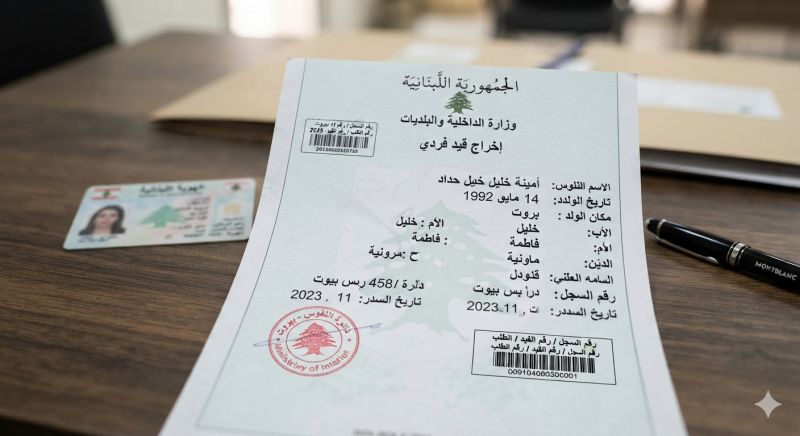
The Individual Civil Registry Extract, also known as the individual statement of civil registration, is an official document issued by the Directorate General of Personal Status under the Ministry of Interior and Municipalities. It contains essential information about a citizen's registration status.
This document is required in numerous official transactions and may be requested alongside an ID card or other documents by certain authorities.
The Directorate General of Personal Status has adopted a unified electronic form for both individual and family registry extracts, which includes a QR code to verify the authenticity of the information.
What Documents Are Required to Obtain an Individual Civil Registry Extract?
According to the Cooperative Fund for Mukhtars in Lebanon, the required documents typically include:
- Two passport-size photos with a white background.
- A copy of an old extract or an ID card.
- A request form for the extract organized by the mukhtar.
- The applicant's personal attendance.
- If the applicant is a minor, the presence of a guardian is required.
It is advisable to confirm the required documents with the mukhtar or the relevant Civil Registry Office before proceeding, particularly in cases that involve special circumstances or updated records.
Where Can You Obtain an Individual Civil Registry Extract?
This transaction can be completed through the Civil Registry Offices affiliated with the Directorate General of Personal Status. The Directorate explains that obtaining a registry extract from the Civil Registry requires a request submitted by the local mukhtar along with the necessary authenticated photos.
The state has also launched an electronic extract service to facilitate citizens' access to registry data.
Can You Obtain an Extract from Your Place of Residence?
Yes, this has become possible in specific cases under the electronic extract system.
The Directorate General explains that a citizen can initially obtain an electronic extract from the place of registration and, afterwards, from their residence following the prescribed procedure.
By March 2026, the Directorate also confirmed that electronic individual registry extracts could be issued from the residence of the applicants in certain instances, especially for those who have previously obtained an electronic individual registry extract following the established terms and procedures.
Steps to Obtain an Individual Civil Registry Extract from the Mukhtar
The typical steps can be summarized as follows:
- Visit the Mukhtar: The citizen should visit the local mukhtar or relevant authority to organize the extract request.
- Prepare Documents: Prepare the ID card or a copy of a previous extract along with the required photos and documents requested by the mukhtar.
- Submit the Request: The mukhtar organizes the registry extract request according to the standard form, and the transaction is then followed up at the relevant Civil Registry Office.
- Issuance of the Extract: After completing the transaction, the extract is issued according to the approved electronic model.
Is the Electronic Extract Recognized?
Yes. The Directorate General of Personal Status has adopted a unified electronic model for individual and family registry extracts, effective since 2023. The new model includes a QR code to verify data accuracy and combat fraud, reducing any ambiguity in information.
The Directorate's website also provides specific templates for both electronic individual and family extracts.
How Long Does It Take to Obtain an Individual Civil Registry Extract?
The processing time varies depending on the Civil Registry Office, the volume of requests, the record's status, and the nature of the transaction. Therefore, there is no standard timeframe for all applicants.
The Ministry of Interior noted in a recent statement that the number of extract requests in the Beirut Registry increased to over 1,500 daily during a certain period, indicating that transaction pressure can affect completion speed.
Can You Obtain an Extract Electronically from Home?
The electronic extract service implies issuing an electronic statement according to the official civil status system. This does not necessarily mean that all steps of the application, payment, and receipt can be completed from home without visiting any authorities.
The Directorate's website provides a description of the service and the application form with related instructions. Therefore, before visiting a mukhtar or the registry office, it is beneficial to consult the official instructions to determine the appropriate procedure based on the registration location and the citizen's status.
What Should You Do If You Lose Your Extract?
If a citizen loses their extract, procedures vary according to the circumstances of the loss and the requested transaction. Internal Security Forces clarify that losing an extract necessitates first contacting the relevant public prosecutor in the area where the loss occurred, then the case is referred to the competent police station to draft a report and deliver a certified copy to the applicant.
Thus, merely informing the mukhtar upon losing a document is insufficient; formal procedures related to lost documents must be followed.
Can Lebanese Citizens Living Abroad Obtain an Extract?
Yes, there is a procedure for Lebanese citizens residing outside Lebanon's territories. The Directorate General of Personal Status notes that registry data can be obtained by submitting a request to its office in Beirut via the Lebanese embassy in the host country, with the necessary approvals and photos.
What is the Difference Between Individual and Family Registry Extracts?
The individual extract pertains to the registry of a single person and is used to validate their personal and registration data. Meanwhile, the family extract includes information about all family members registered under the family registry.
The type of extract required should be selected based on the requesting authority, as some transactions necessitate an individual extract, while others require a family registry statement.
Tips Before Obtaining a Registry Extract
- Ensure your ID card or old extract is available.
- Prepare the necessary passport-size photos.
- Verify the name, place, and date of birth details.
- Inquire about the required type of extract: individual or family.
- Check if the institution requiring your document prefers a recent extract.
- Keep a copy of the document after receiving it.
- Make sure the electronic extract has a verification code upon receipt.
Can Old Extracts Still Be Used?
The validity of an old extract depends on the authority to which it is submitted and the purpose of its use. In 2023, the Directorate General of Personal Status clarified that individual and family registry data issued since 2017 could be renewed in registry offices and stamped with a statement indicating no changes had been made following the procedures announced at that time.
If a formal authority requests a "recent extract," it is advisable to obtain a new one rather than relying on an old document.
Conclusion
The process of obtaining an individual civil registry extract in Lebanon has been streamlined with the adoption of electronic registry data. Citizens usually start with the mukhtar, prepare the ID or previous extract, and provide the required photos, then proceed with the transaction at the relevant Civil Registry Office according to the record status.
The electronic extract system allows for obtaining the extract from the place of registration initially, then from the place of residence in applicable cases.
See Also