


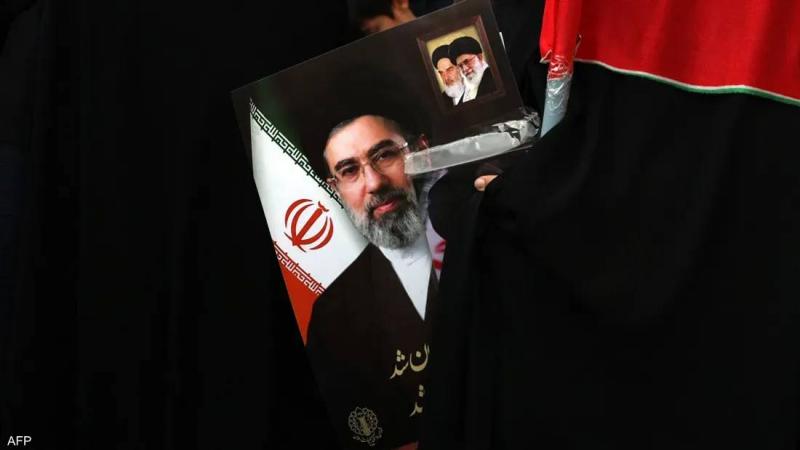
Six months after the air raids that sparked a war and thrust Mojtaba Khamenei into the role of Iran's supreme leader, he remains conspicuously absent, having sustained severe injuries. This absence has led to a leadership void at the heart of the country's governance.
Many questions arise regarding his health and role, particularly as Iran faces critical decisions amid a war that has further strained an already fragile economy in the Middle East.
Iranian officials and other high-ranking sources claim that Khamenei is still in control, managing state affairs from behind the scenes for security reasons, while recovering from his injuries, which have severely altered his appearance. Key responsibilities have reportedly been delegated to a group of senior officials.
In the absence of new images, videos, or even audio messages since his appointment a week after the war began, skepticism has grown among Iranians concerning his position in a nation where the supreme leader is supposed to have the final say in all matters.
Alex Vatanka from the Middle East Institute in Washington stated, "The question is no longer whether Mojtaba is alive, but whether Iran still has a fully functioning supreme leader."
Khamenei's communications with the Iranian public have been limited to a handful of written statements read by news anchors, and he was notably absent from his father's funeral ceremonies last month.
Senior officials and insiders attribute his absence to assassination fears, stating he holds regular meetings with top officials, receives all major reports, and makes the final call on critical issues.
President Masud Bezaskian stated on August 10 that he had a seven-hour meeting with Khamenei.
However, doubts are beginning to emerge even among Iran's staunchest supporters.
A member of the Basij forces in Qom, the religious education center, mentioned, "We need to hear our leader's voice or see any sign that he is leading the country to give us more confidence."
The Basij member, who requested anonymity to discuss such a sensitive topic, believes that Khamenei is still making key decisions, but the lack of even a single image weakens morale and does not benefit Iran.
Among Iranians opposing the ruling regime or seeking comprehensive reforms, the message is clearer.
Shahrokh, a pro-reform businessman in Tehran who also requested anonymity, said, "How do we know that Mojtaba hasn't been killed?"
He added, "It doesn't make sense that there's not even a single indication to prove he is still alive, let alone involved in decision-making."
The Revolutionary Guard as a Core Power Structure
Iran has withstood six months of war with its most formidable adversaries, leaving it exhausted but still standing. Its political system has remained intact, and its military retains the capability to disrupt global energy supplies and target U.S. allies in the Gulf.
The ruling clerical establishment has shown its ability to absorb the absence of the supreme leader and other senior military leaders without collapsing, maintaining a politically and militarily loyal hierarchy to its religious ideology.
However, the Iranian economy struggles under the weight of the war's cost and months-long sanctions on oil exports, leading to the depreciation of the rial and fueling the specter of mass protests, which authorities suppressed in January by killing thousands of demonstrators.
Meanwhile, the ruling establishment has reorganized around the primary goal of preserving the state, restoring deterrence capabilities, and preventing economic repercussions from destabilizing the country.
Sources indicate that the Revolutionary Guard, a historically influential force, has gained more power since the war began and remains central in strategic thinking at the top of a restructured regime around the Supreme National Security Council.
This elite group includes senior Revolutionary Guard commanders, alongside prominent figures like Bezaskian and Parliament Speaker Mohammad Baqer Qalibaf.
Several high-ranking sources contacted by Reuters in Iran confirmed that Khamenei is indeed meeting with these key figures and is thoroughly involved in discussions, possessing the final word on all crucial issues.
An Iranian senior official stated that only a limited number of officials maintain direct contact with Khamenei, and that the lack of details about him is a cautionary measure to prevent information leaks that could enable the U.S. to target him.
A person close to Khamenei's inner circle reported that his health is significantly improving, emphasizing his quick wit and involvement in decision-making.
Another official noted, "Despite all the pressures, public services have not ceased, our foreign policy aligns, and decisions remain consistent. All these signify that the supreme leader holds the reins."
Even before the war, Khamenei preferred working behind the scenes as the chief aide to his father, avoiding the limelight. According to high-level sources, the injuries he sustained in the early hours of February 28, when Israeli and U.S. airstrikes claimed his father's life, have disfigured his face.
However, after assuming a position that bestows significant religious status and during the most severe crisis since the 1979 Revolution, such concerns seem insufficient.
Vatanka remarked, "Any real agreement with Washington requires unambiguous approval from Mojtaba, as does any decision to continue a prolonged and costly confrontation with the United States."
He added, "His prolonged absence has created a dangerous situation where all competing factions can claim they know what the supreme leader truly desires."