


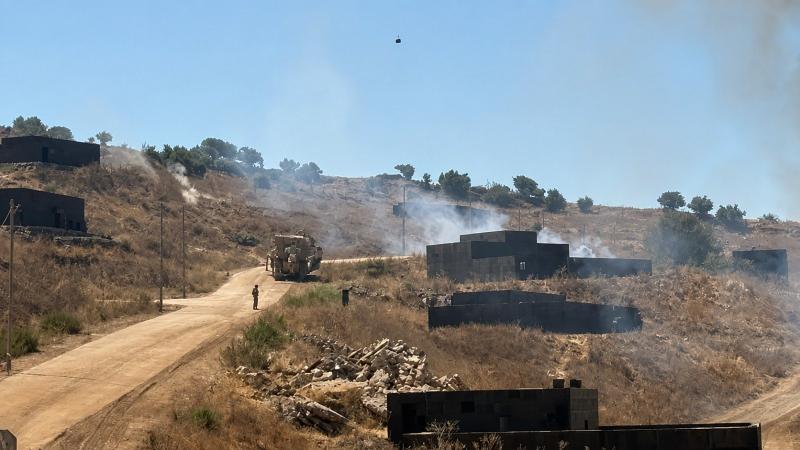
The Israeli army has unveiled a new training facility in the Golan Heights designed to simulate a Shiite village in southern Lebanon. This elaborate setup includes closely packed buildings, narrow streets, and underground tunnels to prepare troops for large-scale combat scenarios involving tanks, infantry, engineering units, drones, and robots.
According to a report by journalist Avi Ashkenazi in the newspaper "Maariv," the 'Lebanon Facility' hosted a live ammunition exercise on Thursday morning. This event featured explosions, tank shell firings, and preliminary operations executed by combat helicopters, while the engineering corps deployed robots to clear paths for advancing armored and infantry units.
The exercise engaged reconnaissance and assault drones, including large suicide drones and others that deployed anti-tank bombs in an environment simulating combat in densely populated areas with narrow streets and underground routes.
Cadets from the company commanders' course led the exercise, which also included participants from the ground forces officers' course across armored, engineering, infantry, and commando units, along with trainees from brigade and battalion commanders' courses, showcasing a comprehensive representation of various tactical command levels within the Israeli military.
The facility features both ground-level and multi-story buildings, connected by tunnels, with streets that offer entrenched defenders an advantage in surveillance and firing on advancing forces.
The Israeli army asserts that the facility is designed to replicate as closely as possible the conditions their forces could face in future battles, drawing from tactical expertise amassed over the past three years, particularly in adapting to new technologies and evolving opponent strategies and defenses.
The training adopted a combat formation involving restructuring armor, engineering, and infantry units. Each battalion-level combat team consists of four companies: tanks, infantry, combat engineering, and forward logistical support, with each brigade commander overseeing three such battalions.
A senior Israeli ground forces official commented that while the core of battle remains unchanged, the dimensions of combat have evolved, emphasizing that the integration of drones, robots, and technology requires commanders to operate across more fields simultaneously.
During the exercise, various drones, including the "Bat" drone, were utilized for reconnaissance and attacks. The army noted that each battalion commander now wields a "mini air force" to gain a broader battlefield perspective.
The plan involves blending engineering to clear advance routes, tanks to provide protection and firepower, and infantry to control flanks and buildings while protecting armor from anti-tank teams, culminating in focused building and tunnel clearing.
As part of the exercise, the maneuver battalion was tasked with occupying the village area, starting with robotic systems to open roads and dismantle explosive fields, weakening anti-tank capabilities. Simultaneously, the air and artillery corps conducted preliminary operations, leading the force commander to order infantry units to seize certain buildings as armor moved forward.
An Israeli officer pointed out that commanders must now understand the capabilities and limits of units working alongside them, not just the weapons they command, noting that although tanks provide significant protection and firepower, their operation in varied environments demands precise integration with other forces.
Nonetheless, a military source acknowledged new challenges posed by technology, where digital systems and screens enable real-time information influx but necessitate commanders adapting to a combat style with ever-increasing data and capabilities.
A senior officer involved in the training's planning expressed that adversaries are now likely aware of Israeli military strength. Consequently, they are unlikely to engage in direct defensive battles but may resort to hiding, waiting for Israeli forces to settle and transition from offense to defense before launching targeted attacks against them.
He added that this tactic relies on the recognized sensitivity of the Israeli society to casualties, claiming that "no military force in the Middle East can conduct a defensive battle against the power of an Israeli battalion-level combat team."
The military official concluded that the current challenge lies in integrating the experience gained by soldiers and commanders over years of combat into the training programs, as some soldiers now possess field experience surpassing that of senior officers, with Israel preparing for potential new conflicts in the villages of southern Lebanon.