


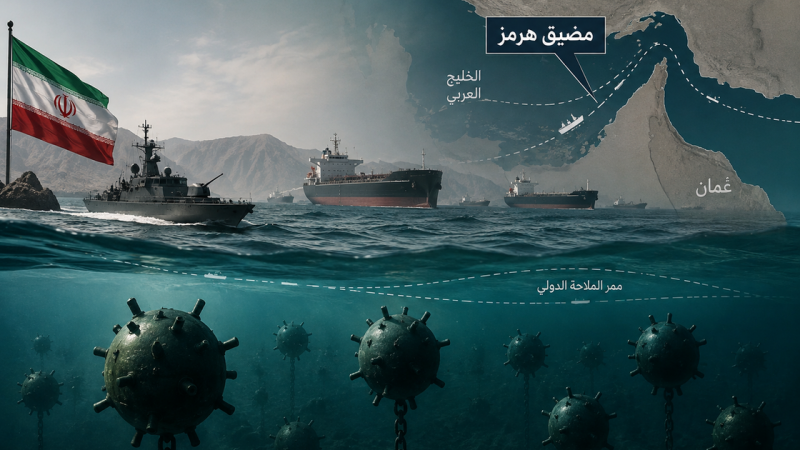
New information has emerged regarding Iran's closure of the Strait of Hormuz at the start of the U.S.-Iran conflict. American and Israeli officials reveal that the former commander of the Iranian Revolutionary Guard's navy, Major General Ali Reza Tangsiri, allegedly ordered the deployment of naval mines within this critical international shipping route, escalating tensions and jeopardizing global energy flow.
According to a report by Barak Ravid on the "Axios" website, two Israeli officials disclosed that Tangsiri orchestrated the move to close the strait during the initial days of the war.
In the first 72 hours, Iran declared the closure of the Strait of Hormuz, warning of attacks on any tanker trying to pass through. Behind the scenes, U.S. and Israeli sources claim that Tangsiri issued a more dangerous order to plant mines within the "Traffic Separation Scheme," the main international pathway for ships navigating the strait.
The report does not present an Iranian response to these claims nor does it provide independent evidence that Tangsiri personally issued the order.
Death Three Weeks Later
As per "Axios," Tangsiri was reportedly killed about three weeks after the war's commencement in an Israeli airstrike targeting Bandar Abbas, Iran.
Iranian attacks on ships, coupled with the mine threats, severely disrupted commercial shipping through the strait. The price of Brent crude surged from approximately $72 per barrel at the outset of the war to a peak of $126 in the following months.
The Strait of Hormuz has since transformed into a pivotal confrontation zone between Washington and Tehran, prompting the U.S. to initiate efforts to reopen the route for vessels.
U.S. efforts included escorting ships through the southern channel, providing aerial support, intercepting drones and missiles, and conducting mine-removal operations involving Navy and "SEALs" divers, as well as unmanned maritime systems.
11 Actual Mines
Washington reports that over 200 mine-like objects were cleared from the main channel, of which only 11 were actual mines, with few correctly deployed according to U.S. officials who spoke to "Axios."
U.S. Central Command leader Admiral Brad Cooper announced that internationally recognized shipping lanes have been cleared of Iranian sea mines, based on the American account.
Washington asserts a shift in favor of the U.S. in the strait over the past two months. However, ship movements and oil flows remain below pre-war levels. U.S. officials report that 20 to 30 tankers now traverse the southern channel nightly, carrying approximately 9 to 10 million barrels, about half of pre-war levels.
Nonetheless, experts and tanker tracking organizations have raised questions about some of the shipping estimates provided by Washington, while reports of ships being targeted by projectiles continue to raise concerns regarding actual safety levels in the strait.
The Trump administration perceives the shift in Hormuz as new leverage over Iran, with American officials believing that diminished Iranian control over the strategic passage could provide Washington with better terms if negotiations resume.