


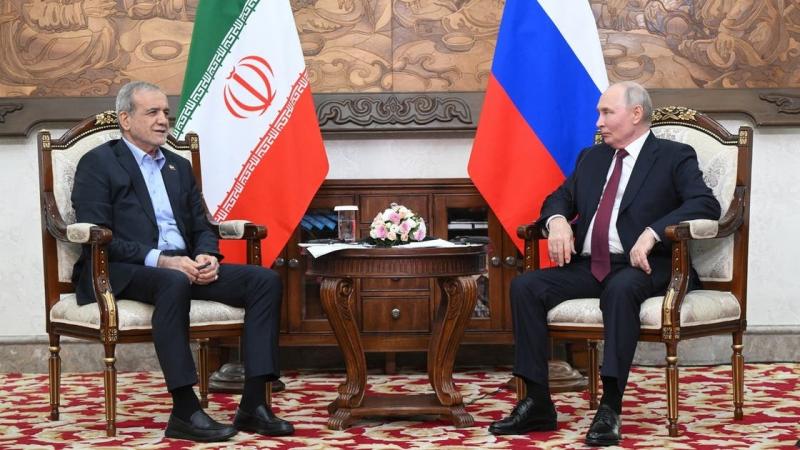
Over the past years, the deepening alliance between Moscow and Tehran has taken a new turn. Leaked Russian communications, travel records, and analysis of military patents reveal that Russia has covertly aided Iran in developing advanced hypersonic cruise missiles. This assistance marks one of the most strategic military technology transfers from Moscow to Tehran.
An extensive investigation unveiled that this multi-year secret program, code-named C430L, enlisted Russia’s top missile experts to assist Tehran in creating a new class of weapons capable of threatening American aircraft carriers and other warships in the Middle East.
Operation During the War
It was uncovered that the program began in 2023 and persisted during the American-Israeli war against Iran, according to the "Financial Times." Leaked communications indicated that discussions about the program continued until the summer of 2026, formulating part of the growing military partnership between Moscow and Tehran.
Arranged through Rosoboronexport, Russia's state arms export agency, in coordination with NPO Mashinostroyenia, a company specializing in missile development, the missile assistance program was set in motion.
Leaked Travel Records
Leaked travel records revealed that Russian officials and top experts from the company made several trips to Iran before finalizing a contract with the Iranian Ministry of Defense in November 2023. By 2025, the Russian company received a substantial amount of technical material from Iran concerning the jet propulsion system. Their engineers analyzed Iranian flight test data and sent detailed inquiries to Tehran about the system's performance.
The queries included modifications to the fuel system, combustion stability, air intake design, and nozzle specifics, probing whether the engine continued functioning after the provided test data ceased, which occurred less than a minute into the test. This exchange demonstrated that Russian engineers were assisting in diagnosing technical issues and enhancing design based on their extensive expertise.
In April 2025, Rosoboronexport proposed sending a delegation of about 24 Russian experts to Iran for technical consultations about the program.
Ramjet Propulsion System
The program's primary goal was to help Iran develop a Ramjet propulsion system, enabling cruise missiles to fly at speeds surpassing the speed of sound multiple times. Missile and military affairs experts noted that this technology is likely intended for anti-ship and land-attack cruise missiles.
Experts suggested that Iran mastering this technology could eventually allow it to develop new generations of hypersonic cruise missiles and reduce dependency on foreign suppliers, providing its defense industry with a long-term strategic boost.
Approval from High Levels
Fabian Hinz, an expert on Iranian missiles and senior analyst at the UK-based Conflict Armament Research, emphasized that this program represents a "highly sensitive and strategic military technology transfer from Russia, a technology Iran has been seeking for decades." He added that such a program requires political approval from the highest levels in Russia.
Jim Lamson, a former military analyst at the CIA, stated: "This weapon gives Iran an entirely new strategic system capable of threatening US Navy ships."
Nichole Graefsky, a political science professor at the "Sciences Po" in France, viewed this program as showing Russia's intent to expand the Ukrainian war and lure the US into other theaters, demonstrating its dwindling concern for red lines in the region.
Hypersonic cruise missiles combine speed and the ability to fly at low altitudes, reducing the available time for air and missile defense systems to detect and intercept them.
The investigation further noted that Iran successfully built and tested the jet propulsion system, though there is no evidence of a hypersonic cruise missile being developed with Russian assistance yet deployed.
Previously, Iran had supplied Russia with Shahed drones, which became a significant element in the war in Ukraine, and helped establish production lines for these drones within Russia.
Alongside this, Ukrainian and Western officials have accused Russia of providing field support to Iran during its conflict with the US and Israel, including satellite imagery, drone support, and weapons components.