


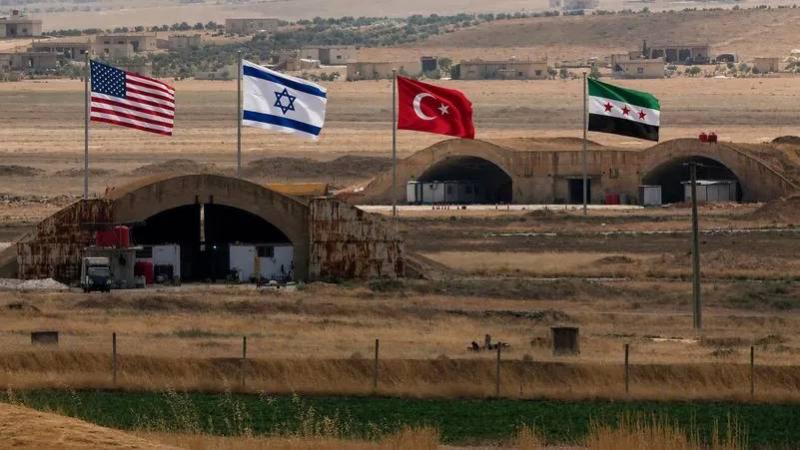
Recent months have highlighted the 'vital' interests every geographically neighboring country has in the new state of Syria, and similarly, the United States under President Ahmad Al-Shareh has vested interests.
The Israeli airstrike on a Syrian airport two weeks ago underscores a clear conflict of interest between the two nations, as Israel seeks to establish a security and political reality in Syria.
Turkish Persistence
According to sources from "Al Arabiya" and "Al Hadath" in Washington, Israel has informed the United States, and directly via Washington to Turkey, that it refuses any Turkish presence on Syrian soil.
Turkey, on its part, sees numerous roles for itself with the new state and has maintained a military presence in the north for years, striving to secure its influence toward Damascus wherever possible.
"Al Arabiya" and "Al Hadath" sources confirm Ankara received Israeli warnings about its military maneuvers, yet persisted with a form of military deployment. Israeli forces monitored these movements, and the government of Benjamin Netanyahu, according to our sources, interpreted Turkey's actions as a military positioning at the Abu al-Duhur base.
Israeli Firmness
Sources in Washington reported that Israel sent images, data, and documents to the U.S. proving Turkish military deployments despite warnings. Subsequently, Israeli aircraft launched what they called a "small and limited" airstrike on the airport to underline the serious nature of tensions with Syrians and Turks, that shouldn’t be underestimated.
Israelis openly claim an issue with U.S. Ambassador in Ankara, Tom Barrack, who is the special envoy to Syria and Iraq, though "Al Arabiya" and "Al Hadath" sources assert that during heightened Israeli-Turkish tensions, the U.S. aimed to maintain impartiality between its allies.
Barrack and Washington's Stance
Diplomatic sources in Washington report an agreement for de-escalation, with the Amman meeting outlining positions anew - though these clear positions entail major risks. Turkey, backed by factions within the U.S. administration including Tom Barrack, aims for a greater role in Syria. Nonetheless, Israel warns Syrians and Americans against Turkish external influence in Syria—both security and economic—that Israel perceives as undesirable, not wanting to replace Iranian influence with Turkish political and security control, nor have whom they consider "terrorists" at its borders. Israel’s message to Syrians in Amman last month was "Don’t let Turkey exploit you."
U.S. Eyes on ISIS
The U.S. hasn't found a clear resolution between the two nations, acknowledging both have valid reasons. The U.S. sees Turkey playing a very positive role in Syria, aiding on the ground in fighting ISIS and collaborating with the Syrian government and its security and military agencies.
An American official told "Al Arabiya" and "Al Hadath" that "The U.S. withdrew its forces from Syria, but we continue to monitor from a distance, deliberately."
The official further noted that "The U.S. has relocated many dangerous ISIS detainees to Iraq to ensure they remain in secure facilities. We will continue monitoring and are positioned to address any threats from ISIS."
Impending Tensions
The U.S. official reiterated America's readiness against "terrorist" threats, but the administration and regional parties, Turkey and Israel, haven’t declared reaching a clear agreement amidst conflicting plans. Turkey is concerned by Israeli actions, while Israel remains adamant about preventing Turkish military and political footholds in Syria, stating distrust towards Ankara and Tom Barrack.