


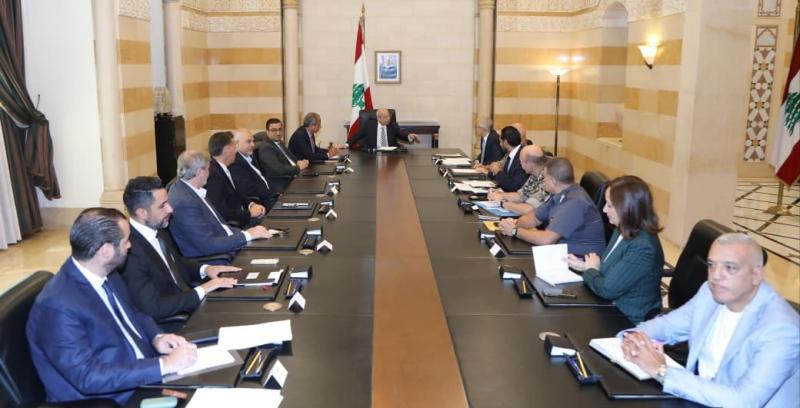
At noon today, Lebanese Prime Minister Nawaf Salam presided over a meeting at the Grand Serail focused on addressing the challenges posed by private generator bills and their rapid price increase. The meeting aimed at intensifying measures against billing violations, attended by Minister of Economy and Trade Amer al-Bisat, Minister of Energy and Water Joe Saddi, Public Prosecutor at the Court of Cassation Judge Ahmad Rami Haj, Director General of State Security Major General Edgar Loundos, Head of the Information Division Brigadier General Mahmoud Qubrosi, Beirut Police Commander Brigadier General Emad Jamal, Director General of the Ministry of Economy and Trade Dr. Mohammad Abu Haidar, and Major Rami Shuqair from the Information Division.
Post-meeting, Minister al-Bisat read a statement from Prime Minister Nawaf Salam:
“We are acutely aware of the burden imposed by high generator bills on Lebanese families, especially during the summer months when air conditioning becomes a necessity.
We acknowledge the economic realities that include a global diesel price surge in recent weeks, leading to a significant rise in the Mediterranean market for low-sulfur diesel, exceeding $1,300 per ton by late August.
The impact was felt in Lebanon, with diesel drum prices climbing from approximately 1.78 million LBP on July 7 to about 2.399 million LBP by August 21, an increase of around 35%. The official kilowatt-hour rate in coastal and densely populated areas rose from 40,746 LBP in July to 48,241 LBP in August, a hike exceeding 18%.
Thus, while we acknowledge a justified increase in costs, there are also unjustified hikes.
The rise in diesel costs cannot be used as an excuse to exploit citizens’ need for electricity or to violate official pricing standards by adding unauthorized charges or fees. The monthly set rate already considers diesel costs, operational expenses, maintenance, and profit margins.
We adopted a clear model in Tripoli and Mina to tackle violations through collaboration between the Ministry of Economy and Trade, security forces, local authorities, and the judiciary. Violators were fined, and generators were sometimes confiscated where legal conditions required, ensuring uninterrupted service for residents.
Today, we decided to extend this mechanism across Lebanon.
The Ministry of Economy and Trade and the Directorate of Consumer Protection will intensify inspections and issue fines. We agreed on a direct operational link between the ministry, local authorities, public prosecutors, and security forces to ensure swift transition from violation spotting to judicial referral and implementation, potentially leading to generator seizure.
When a generator supplying a specific area is seized, it will be handed over to local authorities to ensure continual service, preventing residents from bearing the consequences of a generator owner's violations. Governors, district officers, and municipalities will play a direct role in implementing this across Lebanon.
To be clear: the official rate is non-negotiable, and compliance with meters is mandatory. No one has the right to arbitrarily add fees to consumer bills.
We won't rely solely on warnings or unenforced fines. We demand a clear and quick path: detection, fine, judicial process, legal directive, and execution.
Anyone thinking they can exploit the public’s electricity needs under the assumption that the state will overlook infractions is mistaken. We are vigilant, and the law will be enforced on everyone.
Simultaneously, we must be candid with the Lebanese about the enduring nature of this issue, which predates this administration and can only be sustainably resolved through electricity sector reform.
Our government has embarked on reforming the electricity sector, reducing losses, boosting collections, and enhancing transmission and distribution networks. However, addressing decades of accumulated challenges and improving production and supply will take time to yield results.
Generators are a symptom of the electricity crisis, not a permanent solution. Hence, we are concurrently working to reform the sector for a sustainable solution while protecting citizens from exploitation until public supply improves.
The state's duty is evident: to safeguard citizens, provision their needs, enforce laws, and hold violators accountable. This process has begun, and we will continue with it.
I urge citizens to promptly report any violations and file complaints with the Ministry of Economy and Trade via the ‘MOET Digital Services’ app or the Consumer Protection online platform, or by calling the hotline 1739. Every documented complaint assists state agencies in taking action and holding violators accountable.”