


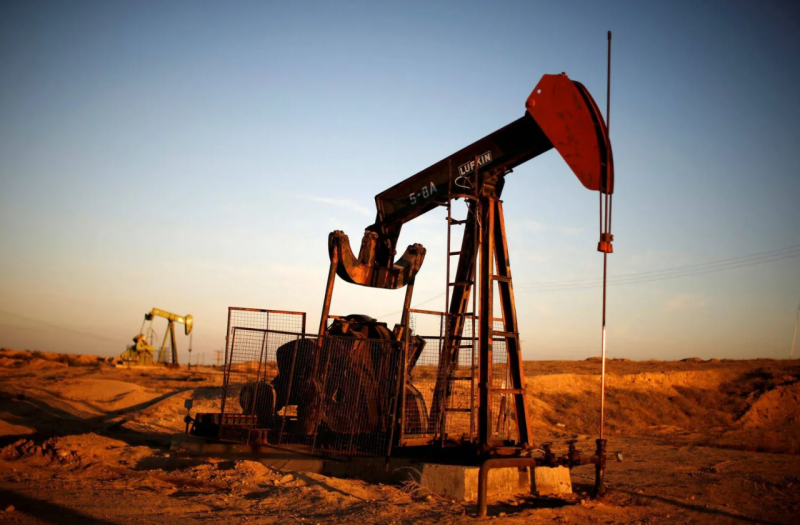
Oil production rankings vary based on how production is measured. Some statistics might include only crude oil, while others incorporate petroleum liquids and other products. This classification is based on crude oil and lease condensate production data for 2025 from the U.S. Energy Information Administration, which is the latest annual data available.
Ranking of the Top Oil Producers by Average Daily Production:
1. United States
The U.S. is the largest oil producer in the world, with an average of approximately 13.586 million barrels per day in 2025. The U.S. has maintained the top spot since 2018, surpassing Russia, and reached a record production level in 2025, largely driven by shale oil growth and productivity improvements in major basins. The Permian Basin in Texas and New Mexico is a key production center, accounting for about 48% of U.S. oil output in 2025.
2. Russia
Russia ranks second globally with production around 9.885 million barrels per day in 2025. Oil is crucial to Russia's energy sector, supported by a broad base of oil fields and infrastructure for production, transport, and export. Despite recent energy trade restrictions, Russia remains a top oil producer.
3. Saudi Arabia
Saudi Arabia ranks third globally, producing about 9.556 million barrels per day of crude oil and lease condensates in 2025. The kingdom plays a pivotal role in the global oil market due to its production scale, spare capacity, and historical influence in OPEC. It was the largest crude oil producer in OPEC in 2025, with a crude oil output of about 9.3 million barrels per day, as per organization definitions.
4. Canada
Canada ranks fourth with an average production of approximately 4.964 million barrels per day in 2025. The country holds significant oil reserves, particularly in the oil sands of Alberta, and the oil and gas industry is a crucial economic component, closely linked to the U.S. energy market.
5. Iraq
Iraq ranks fifth globally, with production of about 4.388 million barrels per day in 2025. As a leading Middle Eastern oil producer, most resources are concentrated in the southern fields, with key deposits across other regions, sustaining its strong position in the global market.
6. China
China is sixth with a production of about 4.325 million barrels per day in 2025. Despite being a major producer, China's consumption makes it a top importer. It focuses on enhancing extraction efficiency to bolster energy security and reduce dependency on imports.
7. Iran
Iran ranks seventh with an average production of approximately 4.051 million barrels per day in 2025. With significant resources, despite geopolitical tensions and sanctions affecting its production and export capabilities, Iran remains a key global oil player.
8. UAE
The UAE holds eighth place, producing about 3.771 million barrels daily in 2025, largely from Abu Dhabi's vast resources. Investments in increasing hydrocarbon production capacity have fortified its infrastructure.
9. Brazil
Brazil ranks ninth, producing about 3.769 million barrels per day in 2025, closely following the UAE. Its oil prominence is due to deepwater and pre-salt fields, driven by advancements in offshore drilling technology.
10. Kuwait
Kuwait closes the top 10 list with an average of about 2.584 million barrels per day in 2025. Oil is a backbone of its economy, with considerable reserves relative to its size and population.
Which Country Produces the Most Oil?
The United States is the leading oil producer, averaging around 13.6 million barrels per day in 2025, a record level, benefiting from shale oil advances and increased productivity in major fields.
Is Saudi Arabia the Largest Oil Producer in the World?
No, Saudi Arabia ranks third globally in 2025 after the U.S. and Russia when considering crude oil and lease condensates. Nevertheless, it holds exceptional significance in the oil market as OPEC's largest producer with significant spare capacity.
What is the Difference Between Oil Production and Petroleum Liquids Production?
There's a distinction in statistics when comparing oil-producing countries. Crude oil and lease condensate production are different from total petroleum and other liquids production, which includes natural gas liquids among others. For instance, the U.S. petroleum and liquids production reached about 23.6 million barrels daily in 2025, far exceeding Saudi Arabia's 11.2 million barrels daily. Production type must be specified when listing top oil-producing nations.
Why Do These Countries Lead in Global Oil Production?
Leading production is linked to factors like significant reserves, large-scale fields, advanced extraction technology, continuous energy investment, developed transportation infrastructure, market access, major oil companies, and expertise in exploration. The significance of each factor varies by country, with U.S. production thriving on shale oil and technology, while Gulf countries leverage traditional giant fields and abundant reserves.
Does the Ranking of Oil-Producing Countries Change?
Yes, rankings can shift annually due to production adjustments, new field developments, oil prices, investments, geopolitical crises, sanctions, and changes in global demand. The Energy Information Administration highlights notable shifts in global production during 2025 and 2026, influenced by geopolitical developments.
When discussing the world's top 10 oil-producing countries, it's essential to specify the year and type of production used, rather than presenting rankings as static.
See Also:
Top 10 Gold-Producing Countries in the World
Top 10 Coal-Producing Countries in the World
Countries with the Most Metals in the World