


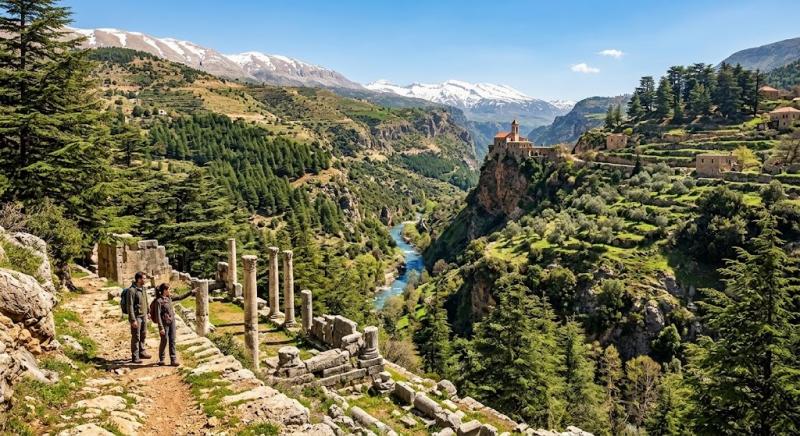
Lebanon is a vibrant tourist destination, boasting a rich diversity of landscapes despite its small size. The country offers a blend of Mediterranean coastlines, high mountains, valleys, forests, rural areas, and ancient cities that showcase traces of Phoenician, Roman, Byzantine, Umayyad civilizations, and more. According to the Lebanese Ministry of Tourism, Lebanon's geographical diversity, encompassing coasts, peaks, and lush valleys, sets it apart.
This variety holds special allure for history enthusiasts, with Lebanon boasting seven UNESCO World Heritage Sites, including Byblos, Baalbek, Tyre, Anjar, the Qadisha Valley, and the Forest of the Cedars of God. Added to this list in 2026 are the Rashid Karami International Fair in Tripoli and the Jabal Amel castles.
Top Natural Attractions in Lebanon
Qadisha Valley and the Forest of the Cedars of God
The Qadisha Valley is a prominent destination blending natural beauty with religious and cultural history. The valley features steep rocky cliffs and rugged mountain terrain, dotted with ancient monasteries and hermit sites, presenting a scenic meeting of nature and human heritage. The valley, along with the Forest of the Cedars of God, has been a UNESCO World Heritage Site since 1998, noted for numerous monasteries dating back to the beginnings of Christianity. The cedar forest is perched between 1,900 and 2,050 meters, perfect for nature walks, photography, and exploring historical sites.
Shouf Biosphere Reserve
The Shouf Biosphere Reserve is a key natural attraction in Lebanon, ideal for forest and mountain trail enthusiasts. It is one of Lebanon's notable reserves that includes vast cedar forests and diverse mountain environments. The Lebanese Ministry of Environment highlights Shouf, Tannourine, Ehden, and Jaj reserves as significant remnants of Lebanon's cedar forests, making them vital destinations for nature explorers.
Tannourine Cedars Forest Nature Reserve
For those seeking forested and mountainous adventures, Tannourine Cedars Forest Nature Reserve offers an outstanding natural experience. Located in the Batroun district, it features cedar trees and mountain views suitable for nature excursions. This area retains significant ecological value, as part of Lebanon’s preserved cedar environments, included in the national network of natural reserves.
Top Historical Sites in Lebanon
Byblos
Byblos is essential for history aficionados, combining ancient city charm, coastline, and historic ruins spanning thousands of years. UNESCO describes Byblos as one of the oldest Phoenician cities, continuously inhabited since the Neolithic era, with relics from the Bronze Age, Persian, Roman, Byzantine, and Ottoman periods. It is also pivotal in the spread of the Phoenician alphabet. Visitors can enjoy historical neighborhoods, explore archaeological sites, and embrace seaside city vibes.
Baalbek
Baalbek ranks high among Lebanon's must-visit historical sites, especially for those interested in Roman civilization and ancient architecture. It boasts a vast archaeological complex with notable temples like Jupiter, Bacchus, and Venus. UNESCO hails Baalbek as a premier example of Roman imperial architecture, highlighting a 200-year span of grand construction projects.
Anjar
Anjar offers a unique historical journey, primarily linked to the Umayyad civilization and early Islamic urban planning. Founded under Caliph Al-Walid Ibn Abd al-Malik in the early 8th century, its ruins reveal a fortified city plan with walls and towers, bridging Byzantine influences and Islamic architecture.
Tyre
Tyre blends history with coastlines, making it ideal for travelers who want both ruins and sea. As a crucial ancient Phoenician city, it houses significant Roman ruins and was UNESCO-listed in 1984 for its historical value and Phoenician cultural role.
Destinations Combining Nature and History
Batroun
Batroun uniquely meshes coastal heritage with maritime nature. It allows visitors to transition from historical exploration to coastal enjoyment. Its historic center, part of UNESCO's tentative list since 2019, demonstrates its historical significance.
Shouf
Shouf offers a distinct blend of mountain villages, natural scenery, and architectural heritage, suitable for tours combining nature walks with historical and traditional village visits. Shouf Cedar Reserve stands out as a top natural site alongside historical landmarks.
Tripoli
Tripoli is a cultural haven for history enthusiasts eager to explore northern Lebanon's eclectic architectural history. The city gained extra significance with the 2023 inclusion of the Rashid Karami International Fair on the UNESCO World Heritage list.
How to Choose the Best Tourist Spots in Lebanon
Your choice depends on your travel preferences. If nature and mountains appeal, consider Qadisha Valley, Cedars of God, Shouf, and Tannourine. For a history-centric journey, Byblos, Baalbek, Anjar, and Tyre stand out. Combos of history and coast can be found in Byblos, Batroun, or Tyre.
When to Visit These Attractions
The ideal time varies by destination. Coastal areas like Byblos, Batroun, and Tyre are perfect for trips mixing sea and city exploration, while mountain regions offer different atmospheres in the milder seasons. Nature and trail lovers should check weather conditions before mountain treks, especially in winter or snow-prone times.
Top Natural and Historical Sites
The Qadisha Valley and Forest of the Cedars of God are top choices for mix lovers of mountain landscapes and historical sites, while Byblos is best for history lovers, noted for its long history from the Neolithic era and Phoenician links. Baalbek holds the grandest Roman ruins, perfect for ancient architectural enthusiasts.