


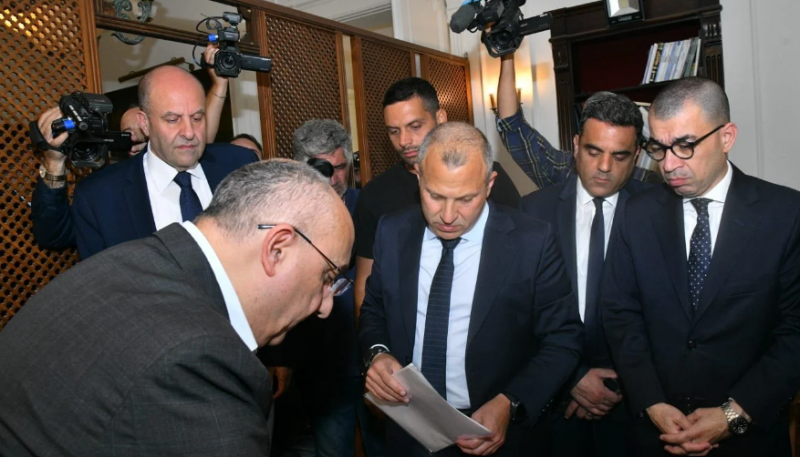
The "Lebanon Strong" bloc has filed an objection against the General Amnesty Law to the Constitutional Council, citing constitutional and procedural violations, as well as concerns related to justice and victim rights, explained Gebran Bassil, head of the Free Patriotic Movement.
In a statement from the Constitutional Council following the submission, Bassil highlighted three primary concerns: justice, victim rights, including military and crime victims, and the cases of untried Islamic detainees.
Bassil emphasized that the bloc seeks the benefit of all and aims to amend the law to include the limited group of Islamic detainees who remain untried, without expanding it to a broader amnesty for other offenders.
He stressed the importance of defending the military, describing sectarian rhetoric as a "major crime," noting that most martyrs are Sunni, and expressing a duty to defend both the military institution and the families.
Addressing critics, Bassil pointed out that these individuals held positions of responsibility, as former prime ministers and justice ministers, who should have addressed the issue of untried detainees.
Constitutionally, Bassil argued that judicial shortcomings do not allow Parliament to bypass constitutional norms, asserting that the constitution permits general amnesty only in connection with specific instances.
He accused the law of being used to, in effect, "free criminals from accountability,” turning it into an amnesty for corruption-related crimes. “We object on behalf of Lebanese who do not want chaos,” he stated.
On procedural grounds, Bassil noted the absence of roll-call voting as a violation not to be repeated, emphasizing the manipulation of public will by passing a law differing from Parliamentary proceedings, labeling it "fraud."
Bassil asserted the law's unfeasibility, referencing the public prosecutor's vocal opposition, and stressing that laws are not clarified through judicial circulars, making such circulars a reason for objection.
He cited the failure to adhere to the law's justifications, like addressing prison overcrowding, emphasizing that the law pardons individuals not yet tried and not imprisoned but under warrants issued in absentia.
Bassil addressed the principle of separation of powers, contending that Parliament cannot legislate contrary to constitutional articles and that such action constitutes judicial interference and disrespect.
He reiterated that general amnesty is an exception while accountability remains the norm, yet the law, in his view, shifts non-accountability to the default, impacting the state's general order. He urged all Lebanese to appreciate lawmakers pushing for corrections.
Warning that reviewing heinous crimes included in the law highlights potential repeat offenses by released individuals, Bassil questioned the link between these criminals and Islamic detainees involved in the amnesty.
He concluded by questioning the law's position on victims and guarantees or compensations owed to them, warning that victims' families fear retaliation due to the law's approval.
The Parliament had passed General Amnesty Law No. 70, covering crimes committed before March 1, 2026, with specific exceptions, placing the "Lebanon Strong" bloc's objection before the Constitutional Council to assess its alignment with constitutional norms.