


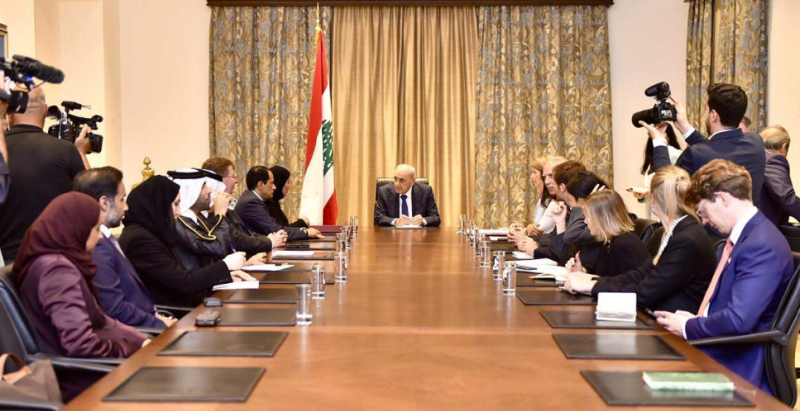
Nabih Berri, the Speaker of the Lebanese Parliament, welcomed a ministerial delegation from Qatar, France, and Britain at the second presidential residence in Ain El-Tineh. The delegation included Dr. Mariam bint Ali bin Nasser Al Misnad, Qatar's Minister of State for International Cooperation; Eléonore Caroit, the French Minister Delegate for Francophonie, International Partnerships, and French Nationals Abroad; and Jennifer Chapman, the UK's Minister of State for International Development. The ambassadors of Qatar, Britain, and France in Lebanon were also present: Sheikh Saud bin Abdulrahman Al Thani, Hamish Cowell, and Hervé Magro. During the meeting, the ongoing situation in Lebanon and the region was discussed, focusing on the humanitarian, social, health, economic, and refugee challenges resulting from the Israeli conflict on Lebanon.
Berri also received former Education Minister Judge Abbas Halabi.
Later in the afternoon, Berri reviewed political and field developments in Lebanon with former minister and leader of the Lebanese Democratic Party, Talal Arslan, in the presence of former minister and political council member Saleh Gharib.
After the meeting, Arslan remarked on the importance of visiting Speaker Berri to express gratitude for his thorough insights and handling of regional events and their impact on Lebanon.
He added that he expressed thanks for Pakistan's support to Lebanon and the agreement reached between the United States and Iran, which positively influences Lebanon amidst tragedies, destruction, and displacement. Gratitude was also extended to all countries that contributed to reaching the agreement, notably Qatar, Saudi Arabia, and Egypt, acknowledging Iran's steadfast stance regarding Lebanon.
Arslan urged the Lebanese government to carefully consider the first clause of this agreement, leveraging it to reassess previous decisions that threatened further division and weakness in confronting Israeli aggression.
He described this moment as a historic opportunity that Lebanese should seize, encouraging a united effort to reclaim Lebanese lands, rebuild the South and the suburbs, and address the displaced. Arslan saluted the southern Lebanese for enduring direct hardships and for their strong resolve.
He praised the recent demonstration of determination as thousands inspected their homes and properties despite threats, emphasizing the importance of unity in safeguarding Lebanese sovereignty and resources.
Arslan further underscored the necessity of internal unity in Lebanon as crucial for confronting external threats and leveraging any positive development accorded to Lebanon. He expressed appreciation for international support but highlighted the collective responsibility to safeguard national achievements and unity for Lebanon's future.