


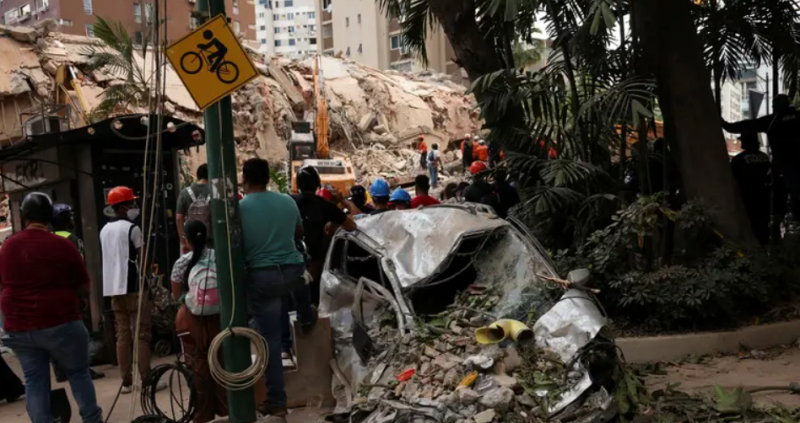
Venezuelans are desperately searching for their relatives trapped alive beneath collapsed buildings, following two powerful earthquakes that have killed at least 235 people and affected neighboring countries.
La Guaira state, north of the capital Caracas, was particularly hard-hit, with residents sifting through rubble, calling out names of loved ones or attempting in vain to rescue the injured as strong aftershocks continued on Thursday.
The first earthquake, with a magnitude of 7.2, struck at 18:04 (22:04 GMT) at a depth of 21.9 kilometers and was located 200 kilometers from Caracas. It was followed by a 7.5 magnitude quake 39 seconds later, with a depth of 10 kilometers, about 45 kilometers away, and approximately thirty aftershocks, according to the US Geological Survey.
Wednesday's earthquake is the strongest to hit Venezuela in over a century since a 7.7 magnitude quake hit northeast of Caracas on October 29, 1900, causing "significant damage."
Health Minister Carlos Alvarado reported the rising death toll on Thursday, noting, "Unfortunately, we have received around 235 people who arrived without vital signs or passed immediately upon reaching our health facilities." The previous toll was 188, with international support and relief teams flowing in from various parts of the world.
Rescue efforts are progressing slowly, with bodies still trapped under debris hours after the quakes, as time runs out for some of the trapped and injured.
In one of the hardest-hit towns in La Guaira, the cries of a young girl pleading for help could be heard.
Danny Rizzo, 48, stated, "We need people... soldiers to come help us so we can get her out," but locals reported to AFP that the girl had died.
The voices of three people were also heard from under the debris of a collapsed building.
Antonio Bermudez, whose building collapsed, said, "There's a place where a young woman named Jennifer answers me, from the eleventh floor. But we have no tools, no means to help her."
He added, "They are still alive... we can’t do anything. We ask them not to strain their voices and to breathe slowly, hoping to save the three trapped there."
According to a doctor at Domingo Luciani Hospital in the city, who requested anonymity, children and adults were arriving by ambulance without family members after being extracted from the rubble, as facilities in La Guaira face immense pressure.
More Rescue Teams Needed
A medic, speaking anonymously to AFP, described the situation as severe, highlighting a lack of trained personnel and significant technical constraints.
Interim President Delcy Rodríguez visited La Guaira on Thursday, declaring it a "disaster area," while UN Secretary-General António Guterres expressed his "deep sorrow" over the catastrophe, affirming the international body's commitment to assist Venezuela.
AFP journalists observed residents looting a store in La Guaira.
Nicole Cast, director of the International Rescue Committee in Venezuela, described the situation as "catastrophic."
Support is pouring in globally, with Switzerland, Spain, France, Portugal, and Mexico sending experts and rescue teams to Venezuela.
Other offers of support came from countries including China, India, Brazil, and war-torn Iran, while Pope Leon XIV donated an initial 100,000 euros to the country.
The United States allocated $150 million in aid to Venezuela, as announced by the US State Department on Thursday, stating that two disaster response teams would also be deployed.
Later, the US Southern Command announced it would send warships, transport aircraft, and helicopters to provide logistical support to Venezuela, stating, "These forces will provide specialized transport services and support to US government personnel, search and rescue teams, and partners from various US agencies as they assess damage, locate affected people, and deliver vital life-saving assistance."
UN Humanitarian Ops Chief Tom Fletcher said the strongest earthquake to hit Venezuela in 126 years would require a "massive collective effort," affirming that the international organization is "fully mobilized" to provide aid.
In a development that could complicate relief efforts, Rodríguez announced late Wednesday the closure of Maiquetía International Airport serving the capital due to "severe infrastructure damage."
Officials confirmed an Italian and Portuguese national were among the fatalities.
Quakes Felt in Neighboring Regions
The northern coast of Venezuela lies between the Caribbean and South American plates. A 1812 earthquake in the region killed around 30,000 people.
The tremors were felt as far away as Colombia's capital Bogotá, despite being 1,000 kilometers away. According to Colombia's Risk and Disaster Management Unit, "there is no tsunami risk on the Colombian Caribbean coast."
Several cities in northern Brazil also reported tremors, according to the seismic network there.
Post-quake, Caracas faced scenes of panic and destruction.
In the upscale Altamira neighborhood, residents called out to relatives after a 22-story building collapsed.
Rita Gomez, 60, traveled to the capital after seeing on social media that her daughter's building had collapsed, while her daughter did not answer the phone.
She told AFP heavy machinery had arrived and "there is a lot of cooperation from neighbors. We hope they can find her alive."