


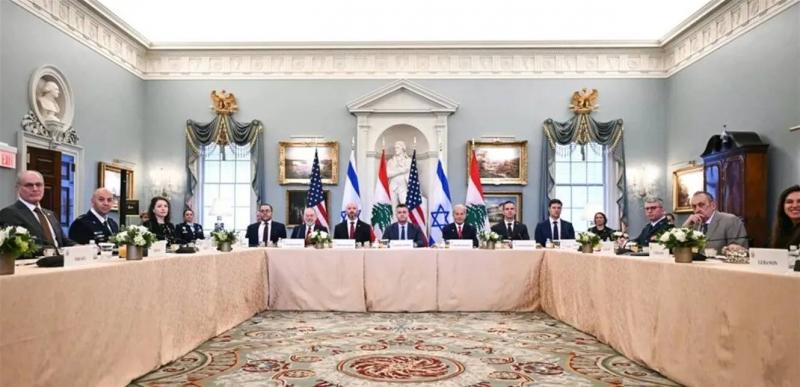
An Israeli news outlet, "Walla," reports that the United States is actively working to establish a monitoring mechanism in southern Lebanon under the supervision of the U.S. Central Command. This development coincides with the extension of Lebanese-Israeli talks in Washington until Friday, aimed at providing Washington with real-time field assessments to prevent any escalation.
As per the report, these efforts are part of a broader U.S. initiative to advance the negotiations, with Admiral Brad Cooper, the U.S. Central Command leader, expected to visit Israel for discussions with the Chief of Staff Eyal Zamir and Defense Minister Israel Katz.
Yesterday, Thursday, journalists waited approximately 11 hours for a significant announcement or the signing of a preliminary memorandum of understanding between the Lebanese and Israeli sides. However, no decisions were made overnight, with talks set to resume on Friday to narrow substantial gaps regarding the disarmament of "Hezbollah" and the withdrawal of the Israeli army.
The negotiations, mediated by the U.S., focus on the future of "Hezbollah" and new security mechanisms in southern Lebanon, while the idea of establishing "experimental zones" is central to the agenda. Security responsibilities in specific areas would be transferred to the Lebanese army after its personnel undergo vetting and training in the U.S. to screen for potential "Hezbollah" links.
Significant gaps persist between the parties; Lebanon insists on a timeline for the Israeli army's withdrawal from currently occupied territories, whereas Israel demands any agreement include "Hezbollah" disarmament, linking the withdrawal to the fulfillment of this condition.
Conversely, political sources in Tel Aviv attributed the extension of the negotiations by an additional 24 hours to U.S. efforts to bridge the gaps regarding the Israeli forces' withdrawal from experimental zones in southern Lebanon, with security responsibilities eventually handed to the Lebanese army pending American assurances, as reported by Hebrew media.
A U.S. State Department official claimed Thursday that Israel had already begun withdrawing from part of the demilitarized zone as a "confidence-building measure," but this was denied by a security official in Tel Aviv.
Israeli Defense Minister Israel Katz asserted that "even if there were an American demand, we would not withdraw from Lebanon," firmly stating that Israeli forces would remain to oversee the enforcement of on-the-ground arrangements.
Israeli sources indicated that the over 11-hour talks session reflects U.S. pressure to achieve a breakthrough in negotiations, though the mood within the Israeli delegation remains tense with concerns. Previously, Israel's ambassador to the U.S., Yehiel Leiter, had likened recent talks with Lebanon to a "train wreck," hinting at complete collapse. He criticized Tehran's influence and parallel U.S. talks with Iranians, emphasizing that the dismantling of "Hezbollah" should remain the cornerstone of any negotiations.