


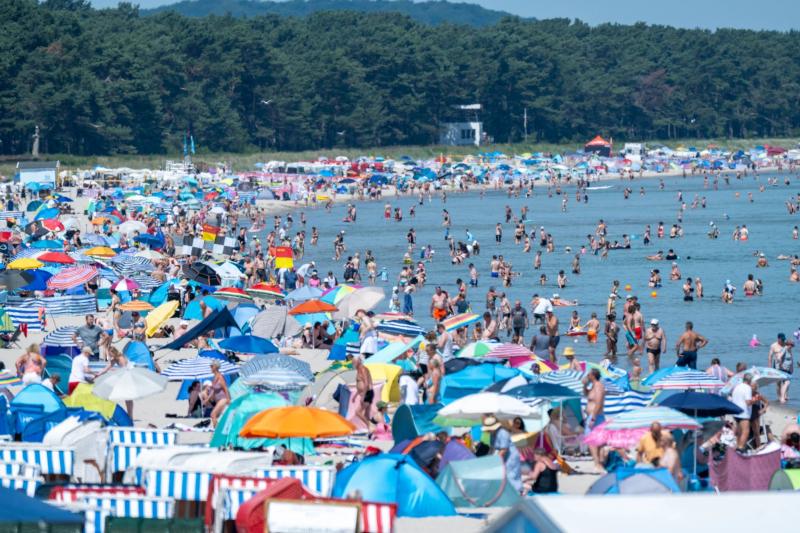
Historically, climate change has sometimes eased European tensions. Between the 9th and 13th centuries, Europe experienced milder temperatures that boosted agricultural yields, which, along with other factors, helped reduce Viking invasions in the north.
However, the current climate change scenario offers little to be optimistic about. The most worrisome aspect of the current European heatwave is not just the scorching temperatures but the possibility that this could become a regular summer occurrence in future seasons.
"Heatwaves are here to stay until we shut down the global emissions tap," says Samantha Burgess from the European Centre for Medium-Range Weather Forecasts. She adds that heatwaves have become "more frequent, intense, and prolonged."
This is the second major heatwave to hit Europe in two months, and the Northern Hemisphere has just begun summer.
In Italy, farmers fear drought as the Po River's levels dropped unusually early. Addressing river levels, France had to shut down two nuclear reactors due to water shortages. The country reported at least 74 drownings by Friday, as people tried to cool down, and four children tragically died in locked cars. Spain recorded 300 heat-related deaths last week.
Denmark experienced record temperatures of 37°C in Aarhus on Saturday, the highest in 150 years. Aarhus, known as the "City of Smiles," might have temporarily lost its cheerful demeanor. Slovakia also broke heat records with nighttime temperatures not dropping below 26.3°C. In Germany, a new record was set with North-Central regions reaching 41.5°C.
In short, Western Europe suffered under what scientists call a "heat dome," with temperatures about 8°C higher than normal for this time of year. On Friday, the World Weather Attribution initiative concluded that climate change is responsible for the current heatwave, a phenomenon that was "practically impossible" 50 years ago.
A new Nature Climate Change study suggested that Europe could face an annual bill of one billion euros for infrastructure damage due to coastal floods if temperatures rise by 1.5°C compared to pre-industrial times. The risk of surpassing this temperature threshold is significantly high.
Allianz Trade simulated a stress test applying the five hottest years from 2014-2024 to the upcoming period until 2030. The findings suggest that France would incur total losses of $240 billion, while Germany and Italy could face losses of $131 billion and $147 billion, respectively.
While Europe has resources to help adapt to global warming, the problem is that it is the fastest-warming continent due to its proximity to the Arctic. Two main factors explain this: the retreating ice cover, which reflects more sunlight than regular soil, and the fresh water from melting ice, which stores heat faster than saltwater.
In 2003, Europe recorded around 70,000 heat-related deaths. By 2023, that number was about 50,000. Despite the continuous temperature rise, Europe is slowly adapting to the warming climate. But, as The Economist noted, Europe needs to reduce climate change risks, not just keep pace with them.
Amidst this crisis, Europe faces rising populist tides, trade tensions with China, and fracturing alliances with the United States, notably over Greenland, exacerbated by global warming. Thus, climate change remains a multiplier of geopolitical threats in Europe, accelerating with the same rapidity as the warming climate over its lands.