


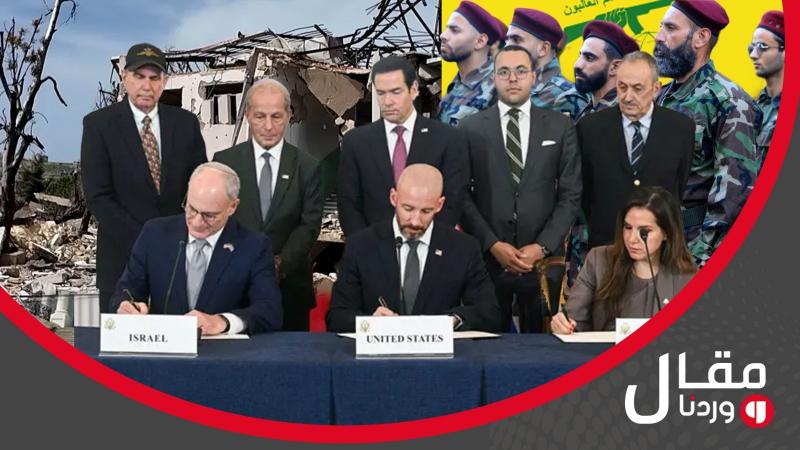
The "Framework Agreement" signed between Lebanon and Israel in Washington is seen as a significant political breakthrough and a diplomatic turning point aimed at ending years of conflict between the two nations. Thanks to American mediation and sponsorship, this agreement seeks to reshape the entire Lebanese landscape. However, the ink had barely dried on the agreement before opposition arose, particularly from the "Shiite duo," notably 'Hezbollah', which argues that enforcing the "Washington Agreement" or terms related to the disarmament of the party is unfeasible, warning that its imposition could lead to civil unrest in Lebanon.
From this perspective, the situation unfolds as follows: one faction considers the agreement dead on arrival, mainly due to its dismissal of the Israeli withdrawal being linked to disarming Hezbollah, advocating that resistance remains the sole deterrent against Israel. Meanwhile, the Lebanese government, upholding the agreement’s implementation, emphasizes that negotiation and the diplomatic route backed by the US, with its ability to exert pressure on Israel, remain Lebanon's only salvation from its ongoing challenges.
This situation places the state under intense examination regarding its commitment to implementing the agreement, especially concerning Hezbollah's disarmament, which already opposes the deal. Meanwhile, the Lebanese army is preparing to deploy its units in the model regions of Fraun and Western Zawtar, coinciding with the visit of US Central Command leader Admiral Brad Cooper to Beirut to oversee the implementation and coordination between the Lebanese and Israeli armies.
As the state faces this crucial test, several questions arise: Can it enforce the agreement despite Hezbollah's control in these areas? How will it address accusations of betrayal linked to the framework agreement, especially considering the attacking faction calls for adherence to the memorandum of understanding between Tehran and Washington? What major challenges could obstruct the agreement’s execution?
Mohammad Zkour, head of the 'Liberty Center for Legal and Strategic Studies,' in an interview with 'Warna', remarked that the US-Iranian agreement and the framework between Lebanon and Israel are interconnected. The party's escalation is merely saving face since serious internal or sectarian strife has not been mobilized, evidenced by the lack of mass protests. Although Hezbollah’s opposition is not absolute, their ministers remain active in government roles, showing no signs of resignation despite questioning the government's legitimacy.
Zkour emphasized that the state cannot forcibly execute the agreement’s terms, as aggressive disarmament could threaten civil peace. Cooperation with the party under a comprehensive regional agreement, which might require intervention from Iran, is essential for meaningful progress.
Ultimately, the greatest challenge lies in whether Hezbollah cooperates voluntarily, as aggressive methods are not feasible. The framework agreement is inherently tied to the broader outcomes of the US-Iranian deal, whose impacts will surface over time.
Concluding his remarks, Zkour noted that the evolving dynamics of the US-Iranian agreement could prompt Iran’s strategic decisions regarding Lebanon. Any forward step by Iran could yield positive local outcomes, while a retreat might have adverse effects, though it seems unlikely that Tehran would relinquish its influence in Lebanon.