


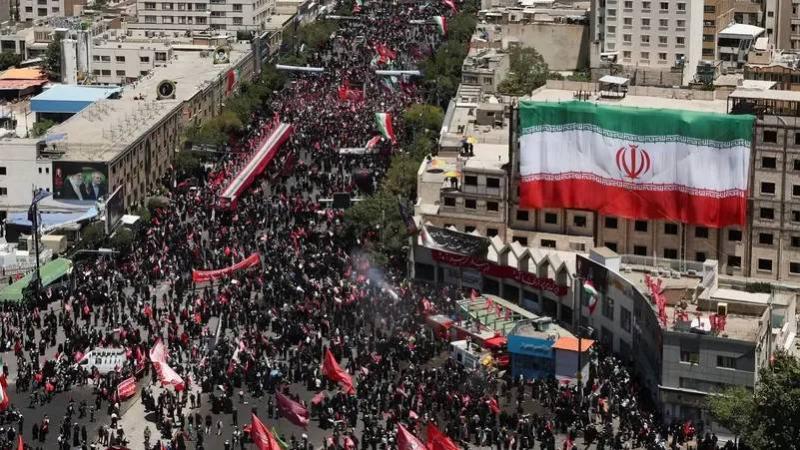
The late former Iranian Supreme Leader Ali Khamenei was laid to rest on Thursday in Mashhad, one of Iran's most sacred religious sites. Notably absent was his son and successor, Mojtaba, who has remained out of sight since a February attack left him with significant injuries following his father's death.
This burial follows a series of large public gatherings and mourning ceremonies, occurring alongside renewed tensions with the United States after a brief period of cease-fire.
On Thursday morning, crowds gathered in the streets of Mashhad as the sun shone on the golden dome and minarets of the Imam Reza shrine, with attendees waving Iranian flags and images of Khamenei while chanting revolutionary slogans.
Last week, as Khamenei's body was transported through cities in Iran and Iraq, clerics and Iranian leaders called for mass participation to demonstrate the regime’s strength and underline its ideological and popular support.
Despite evading a prolonged American-Israeli military campaign, Iran still faces considerable internal challenges. Khamenei's 37-year-long rule remains deeply divisive, according to Reuters.
The Mystery of Mojtaba's Absence
Mojtaba, named Supreme Leader by a council of clerics a week after his father’s assassination, remains a mystery to the Iranian public.
Since the attack that killed his father on February 28, Mojtaba has not appeared publicly.
Though statements have been issued under his name, no images or audiovisual recordings of him have been released.
Sources in Tehran indicate that while Mojtaba is recuperating from severe facial disfigurement and limb injuries sustained in the attack, he is not yet fit to make a public appearance. Security forces are also keeping him sheltered from potential further U.S. attacks, reported Reuters.
As mourners awaited Khamenei’s funeral procession in Mashhad, chants calling for revenge against U.S. President Donald Trump were heard among the crowd.
No less than four family members of Khamenei killed alongside him had funeral ceremonies in Tehran and Qom, Iran’s religious hub, as well as Najaf and Karbala in Iraq.
Each procession drew enormous crowds, chanting Shia slogans and revolutionary cries.
A Legacy of Controversy
The funeral marks a pivotal moment for Iran, closing the chapter on Khamenei's near four-decade reign, following months of nationwide protests against the clerically-led government.
The unrest, fueled by economic woes from sanctions, had been suppressed by security forces resulting in thousands of protester deaths, drawing parallels to earlier violent crackdowns in recent years.
Khamenei rose as Supreme Leader in 1989, following the Islamic revolution, and consolidated political, economic, and military dominance over decades.
This was achieved largely sidelining elected presidents and the parliament, in close coordination with the increasingly powerful Islamic Revolutionary Guard Corps (IRGC).
Mojtaba’s appointment has been supported by the IRGC, now viewed as the paramount force in shaping Iran’s political and strategic ideology.