


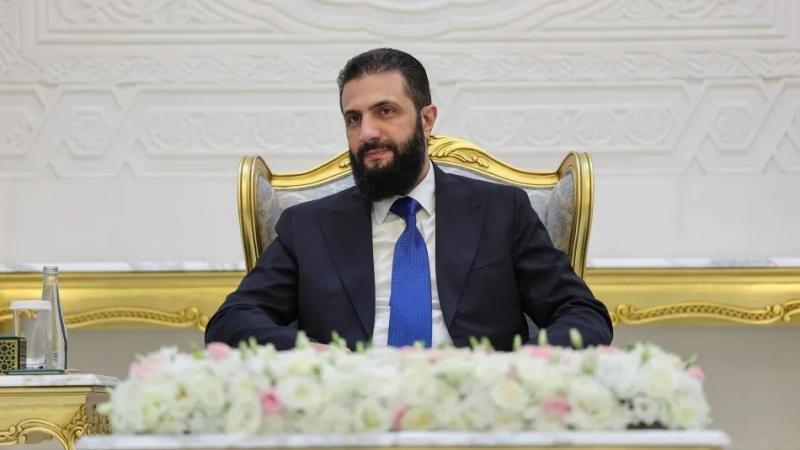
According to an informed source, a high-level meeting took place in mid-July, involving military officials from the Syrian and American sides. During the meeting, Washington reaffirmed its strict demands, notably after Syrian administration under President Ahmad al-Shara sought to avoid military involvement against Hezbollah within Lebanese territory.
This occurs amidst escalating international rhetoric over future influence in the Middle East, raising fundamental questions about potential "Syrian scenarios" in Lebanon. These questions follow repeated calls from U.S. President Donald Trump for Syrian President Ahmad al-Shara to intervene in curbing Hezbollah's influence.
Despite these calls hinting at a resurgence of Damascus's regional role, political and military backstage suggests deeper struggles between Washington’s ambitions, Tel Aviv’s concerns, and Damascus’s "war-weary" priorities.
Inside the "July Meeting": American Conditions and Syrian Maneuvering
The source noted that "the meeting in Damascus was dominated by the presence of military officials from both sides. The American side set forth demands to the Syrian administration, although both sides had previously reached an understanding on these matters."
These demands focus on the issue of foreign fighters, especially establishing a system to monitor foreign fighters and jihadists to prevent attacks on the U.S. and its allies, including the Kurdish-led Syrian Democratic Forces (SDF). Additionally, the program for integrating the SDF fairly was emphasized, marking them as a long-term U.S. partner in combating ISIS. The U.S. renewed its stringent conditions due to Syrian government’s reluctance to engage militarily in Lebanon.
The source further noted that "the Syrian government has not responded to the American demands, preferring to study them in consultation with the Turkish side. Among the initiatives was tightening control over Syrian-Lebanese and Syrian-Iraqi borders, sharing samples of seizures with the U.S., especially a weapons shipment hidden in an oil tanker that contained quality arms. If the pilot regions in Lebanon succeed, pressure on the party from the Syrian side will increase. However, if unsuccessful, there will be re-consultations on military intervention mechanisms and related military and political support."
Damascus: Doors Remain Open
On the official level, al-Shara adopted a cautious discourse emphasizing Syria’s new profile.
Syrian officials remarked that Damascus considered Trump’s proposals to involve them in a direct confrontation with Hezbollah as "unlikely and not on the current agenda," predicting disastrous consequences.
The Syrian leadership stressed their priorities are securing borders, dismantling organized weapon and drug smuggling networks, and supporting the sovereign decision of the Lebanese state.
Though there is an intersection of interests with Washington in limiting Hezbollah’s role, described as "disruptive" in Syria, Damascus insists that the doors of the People's Palace are open to all Lebanese factions, explicitly calling for Hezbollah to "cease its interference in Syria and harboring the remnants of those who have harmed the Syrian people." Nonetheless, President al-Shara dismissed any future desires for military or security intervention in Lebanon, labeling any such rumors as unfounded and underlining the Syrian army and people are unwilling to deplete their capabilities in another external quagmire.
Balancing Political Pressure and Security Partnership
Samer al-Safadi, a political affairs adviser, views Trump’s statements as aimed primarily at pressuring the Lebanese government to address the Hezbollah issue, not as a call for a direct military invasion.
Al-Safadi adds that linking this potential role to past regime actions is inaccurate. Today’s Syrian intervention implies a coordinated security and intelligence role to bolster Lebanese state institutions against unlawful militias, as he states.
Al-Safadi considers Damascus’s thwarting of Hezbollah's arms smuggling operations via the Iraqi border as a practical reflection of this limited security partnership that serves regional stability.
The Israeli Dilemma and Ideological Concerns
Meanwhile, Israel appears in a "strategic quandary." Despite its desire to weaken Hezbollah, Prime Minister Netanyahu’s government fears that Syrian intervention could revive Damascus as an influential regional power, with ties to Ankara.
Israeli Security Minister Yisrael Katz articulated this stance, commenting on Trump's statements by asserting that "Israel doesn’t need President Ahmad al-Shara in Lebanon." The Israeli apprehensions stem from the potential presence of advanced Syrian military on its northern borders, besides concerns over "the complex ideological backgrounds of the new Syrian government," as he described.
Conversely, political writer and researcher Mahir al-Tamran is more inclined to dismiss any field role, viewing the talk about a Syrian intervention as overblown.
Al-Tamran opines that Trump's message is meant for Beirut to reclaim its security decision-making, and not for Damascus to assume on-the-ground roles. He emphasizes that modern Syria’s legitimacy is built on respecting countries’ sovereignty, avoiding the return to conventional power policies. The most likely scenario is a continued collaboration in combating smuggling and border protection only because any military entanglement would expose Damascus to political losses it can ill afford amidst rebuilding, in his perspective.
Al-Mudun