


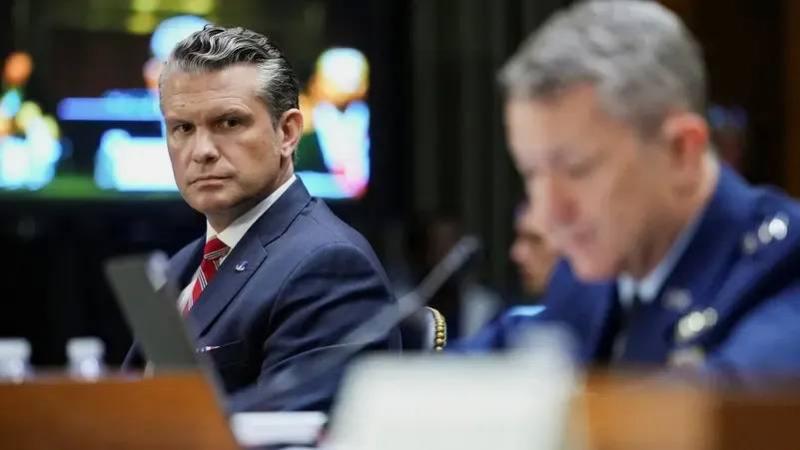
U.S. Defense Secretary Pete Hegseth reiterated on Monday the statements made by President Donald Trump, emphasizing that U.S. forces remain on high alert and ready to act. He confirmed that President Trump's decision to delay a strike on Iran has not impacted military readiness.
He also mentioned on his "X" account that the Department of Defense maintains a level of readiness unseen since World War II, and that the military is fully prepared.
Earlier, President Trump announced a new round of talks with Iranian representatives after temporarily halting plans for further strikes on Iran.
Speaking to reporters aboard Air Force One on his way from New Jersey to Washington on Sunday evening, Trump said the negotiations were scheduled for Monday.
However, he did not disclose the location, duration, or participants involved in the talks.
Trump also reiterated that the U.S. military canceled plans for a new wave of strikes on Iran at the last moment following pleas from Saudi Arabia, the United Arab Emirates, Qatar, and Iran.
He claimed that the planned attack "would have been the largest since World War II and catastrophic for them."
Trump explained that he called off the strikes after U.S. allies suggested a deal seemed close, with Iran also expressing a desire for an agreement.
In mid-June, Iran and the U.S. agreed on a framework intended to end the conflict that began in late February.
To date, there has been no confirmation from Iran indicating that an agreement is near.
Meanwhile, Iranian President Masoud Bazeshkian anticipated recent developments by stating that the "memorandum of understanding with the U.S. will be central to Tehran's external relations in the future."
In a post on "X," Bazeshkian asserted that the memorandum would enhance the security of the country and region.
Prior to Trump's announcement, Iranian Foreign Minister Abbas Araqchi confirmed that Iranian-Omani talks were nearing completion.
The Iranian Foreign Ministry clarified that the agreement on the new Hormuz route is unrelated to opening or closing the strait, indicating that the agreed path will not follow the current northern or southern routes but a new one agreed upon by both sides.
President Trump has repeatedly threatened to escalate the war against Iran, which he initiated with Israel in late February, primarily to allow more time for talks that have yet to result in a comprehensive agreement.