


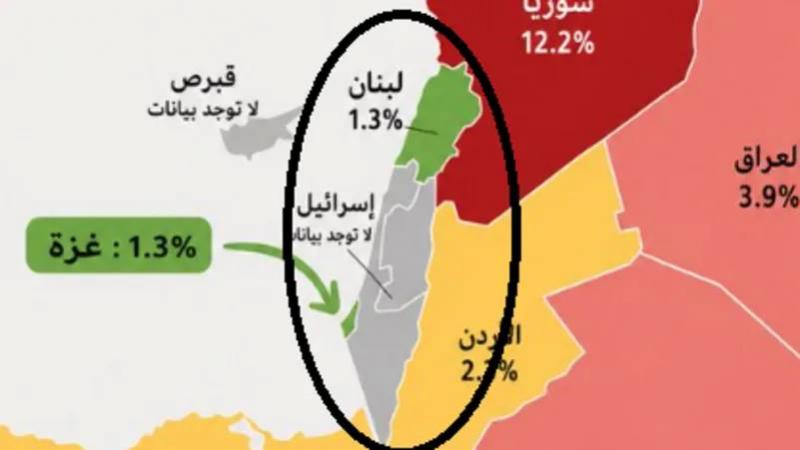
Israel's Foreign Ministry is facing backlash after posting a map on the "X" platform that depicted parts of southern Lebanon as within Israeli borders. The map, part of a post addressing child malnutrition in Gaza, led to widespread controversy.
Following Lebanese diplomatic intervention, the map was removed from Israel's official English-language page, although it remains on the ministry's "Israel in Arabic" account on "X".
A Lebanese diplomatic source told "Al Arabiya/Al Hadath": "We contacted Washington to pressure Israel into removing the map that manipulates borders."
The source continued, "Our efforts resulted in Israel deleting the map that included Lebanese lands within its borders."
The map displayed statistical indicators from a UNICEF survey in Gaza but inaccurately included Lebanese areas within Israeli territories, not aligning with internationally recognized borders.
Hezbollah commented, stating that Israel's inclusion of southern Lebanon in its map evidences "Tel Aviv's ambitions for Lebanon's resources," urging a halt to direct negotiations.
Hezbollah contends that Israel's direct negotiations with Lebanese authorities are transparent attempts to buy time and establish new facts on the ground.
The map's release comes days after the seventh round of Lebanese-Israeli negotiations in Rome, which ended Thursday under U.S. sponsorship. These talks focus on implementing the "Framework Agreement" signed on June 26.
No agreement on the next withdrawal area was reached, with a new round scheduled for early September.
The Framework Agreement outlines a phased Israeli withdrawal from occupied Lebanese territories, initiating with model regions, in exchange for Lebanese army deployment and Hezbollah disarmament.
Israel occupies areas in southern Lebanon, some for decades and others since the 2023-2024 conflict. Recently, Israel advanced over 10 kilometers into Lebanese territory.