


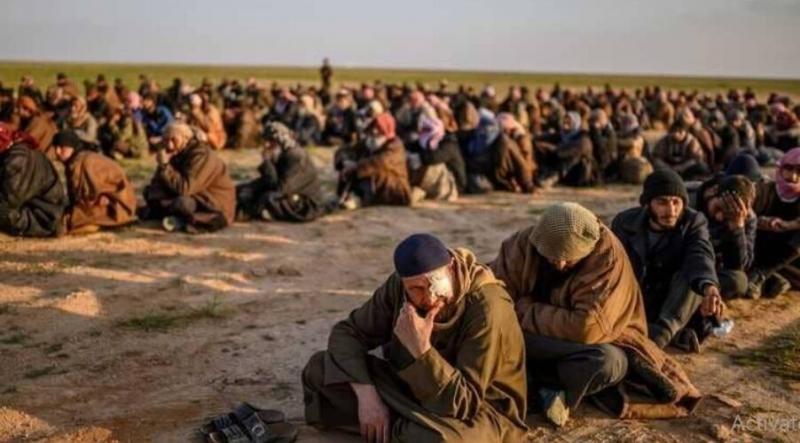
Syria announced on Thursday an agreement with Iraq to establish joint technical committees to address the issue of ISIS detainees in Iraq, aiming for legal resolutions that uphold the rule of law and the principles of justice and international humanitarian law.
Syrian Justice Minister Mazhar Abdul Rahman al-Wais, in a statement to the Iraqi News Agency (Waa), said the detainee issue was a primary subject in his discussions with Iraq's Chief Justice, Faiq Zaidan, who is visiting Syria at the head of a judicial delegation.
Al-Wais explained that both sides agreed to await the outcomes of the joint committees' work in the near future, indicating "promising steps" toward resolving the issue while adhering to established legal frameworks.
The issue of ISIS detainees is a complex security and judicial challenge between the two nations, concerning detainees' nationalities, charges against them, judicial authority for prosecutions, and implications for security and counter-terrorism efforts.
The Syrian minister did not elaborate on specific solutions or numbers involved in the detainee issue. However, the formation of technical and logistical teams suggests a shift from political and judicial consultations to exploring practical handling methods.
Discussions were not limited to ISIS detainees; they also involved bolstering coordination between Damascus and Baghdad in counter-terrorism, organized crime, and drug trafficking responses, given the shared border and security challenges posed by extremist and smuggling networks.
Al-Wais noted that the technical teams have already begun sharing information and coordinating matters, preparing for the drafting of memoranda of understanding with the potential to later formalize legal and judicial agreements, offering a more stable framework for cooperation.
The Syrian Justice Minister emphasized the convergence of viewpoints on enhancing judicial and security coordination, especially on cross-border issues requiring information exchange and collaboration between relevant institutions in Syria and Iraq.
Both parties also agreed to strengthen cooperation in legal and international forums and organize reciprocal visits of judicial officials, supporting institutional collaboration mechanisms between Damascus and Baghdad.
These initiatives arise amid shared security challenges faced by both countries, foremost among them preventing ISIS from rebuilding its networks, securing borders, combatting smuggling, and organized crime, alongside addressing judicial backlogs related to ISIS members and detainees.