


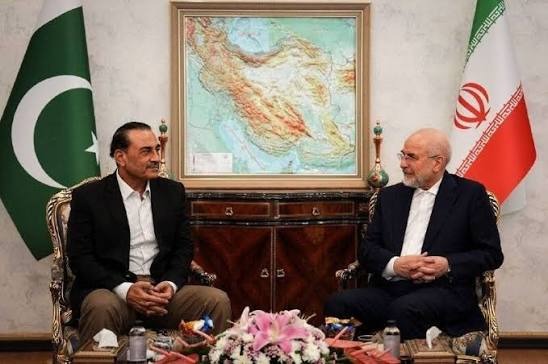
The Iranian Parliament Speaker and chief negotiator, Mohammad Baqer Qalibaf, reaffirmed on Monday that Tehran is committed to the terms of the memorandum of understanding signed with the United States last June, holding Washington accountable for its delay. He made these remarks while welcoming Pakistan's army chief, General Asim Munir, on his visit to Tehran. The visit holds particular significance amidst growing US-Iran economic tensions.
According to Iranian state television, Qalibaf stated that Iran continues to pursue the implementation of the terms outlined in the agreement, emphasizing that both parties’ commitments are well-defined and urging the US to fulfill its obligations.
Qalibaf accused the US of failing to uphold its commitments, impeding regional stability, and exacerbating distrust. His remarks come at a time when US-Iran negotiations are stalled, coinciding with the US escalating its economic pressure on Tehran and threatening to sanction institutions and nations maintaining business with Iran.
General Munir's visit to Tehran, accompanied by Pakistani Interior Minister Mohsin Naqvi, underscores Islamabad’s renewed role in mediating escalating tensions between Iran and the US. Naqvi had visited Iran earlier in August for discussions with Iranian President Masoud Pezeshkian and Foreign Minister Abbas Araghchi.
Munir's visit is particularly timely, following the US administration's announcement of a broad economic campaign aimed at isolating Iran and targeting its trading partners. Reports from three Pakistani sources, via Reuters, indicate that before arriving in Tehran, Munir spoke with US President Donald Trump, further fueling speculation about possible message exchanges or proposals to ease tensions.
The content of the call or its direct relevance to Munir's visit was not officially disclosed, but the two events highlight Pakistan's efforts to mediate between both sides. This Pakistani initiative comes ahead of an expected visit from Omani Foreign Minister Badr al-Busaidi to Tehran, aimed at continuing talks on establishing a new navigation route in the Strait of Hormuz.
Thus, Pakistan and Oman are at the forefront of diplomatic efforts to de-escalate the crisis, each focusing on different yet intertwined paths. Iranian Foreign Ministry spokesperson Ismail Baghaei stressed that Munir's visit is part of efforts to boost Iran-Pakistan cooperation and Pakistan's ongoing support for regional peace and security.
Baghaei described Tehran-Islamabad relations as being in their "best phase," noting both nations' desire to expand cooperation across various domains. The Iranian Foreign Ministry has previously affirmed that communication channels with Pakistan remain open, as Islamabad seeks to leverage its diplomatic ties and political influence to mediate between Tehran and Washington.
Yet, Tehran perceives that the success of such mediations confronts repeated US failure to meet its pledges—a message echoed by Qalibaf during his meeting with the Pakistani army chief.
Pakistan, alongside Qatar and other regional players, was instrumental in de-escalation attempts since the outbreak of conflict on February 28, leading up to the ceasefire in April and the agreement in June. However, disagreements over the implementation of terms, particularly sanctions, blockades, and navigation in the Strait of Hormuz, soon surfaced, with both sides accusing each other of breaches.
As the US intensifies its economic pressures and threatens Tehran's interests, Pakistan's mediation operates within narrow confines between two parties raising their conditions. Munir's arrival in Tehran and the impending visit of the Omani foreign minister represent a new test for reopening diplomatic channels before the crisis intensifies further.