


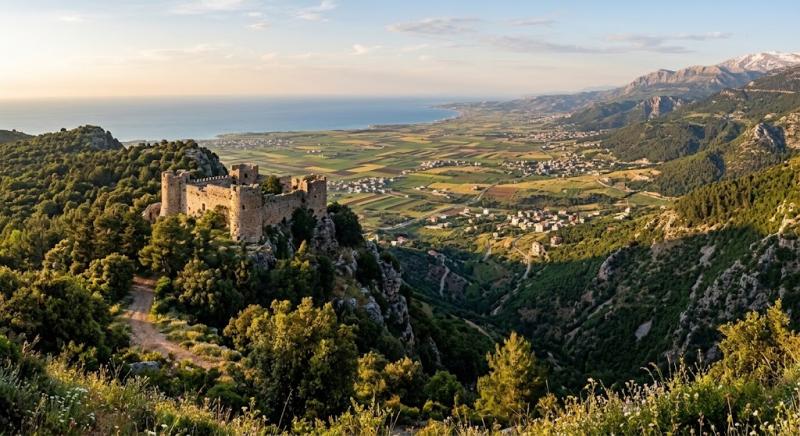
Akkar is located at the northernmost tip of Lebanon, distinguished by its geographical position, serving as a crossroads between the Lebanese coast, inland territories, and the Levant. This advantageous location, coupled with fertile plains and expansive mountainous areas, has facilitated the establishment of human settlements since ancient times.
Discussing the history of Akkar involves more than viewing it as one coastal city; it is a vast historical and geographical region encompassing numerous towns and villages. Among the notable historic landmarks that reveal the depth of this history is the archaeological site of Arqa. The findings indicate a continuous sequence of human settlement spanning thousands of years, establishing this area as key to understanding the evolution of civilizations in Northern Lebanon.
Akkar in Ancient Times
The early history of Akkar is closely tied to the ancient city of Arqa, located in the Akkar plain. Arqa's hill is one of Lebanon's significant archaeological sites, exposing successive layers of settlement from the Early, Middle, and Late Bronze Ages, through to the Iron and Roman ages, and beyond. Lebanese sources note that Arqa was well-known in antiquity, with its name linked to the history of kingdoms and cities in the Levant, appearing in early records under various names before becoming an important site in the northern coastal region of Lebanon.
Arqa and the Phoenicians
Arqa was also connected to the Phoenician world, which flourished along the Lebanese coast and hinterlands. Historical records suggest Akkar's name is historically associated with Arqa. Excavations have unveiled ancient dwellings, temples, defensive structures, water installations, and burials that trace back to the early stages of the site's history. Arqa was not an isolated city but was influenced by the political and military changes in the region, especially with the rise of Assyrian power and its expansion in the Levant.
Arqa in the Assyrian Era
During the Assyrian era, Arqa was embroiled in the regional conflicts. It participated in alliances against the Assyrian king Shalmaneser III in the Battle of Qarqar around 853 BC. Later stages saw more Assyrian campaigns, causing periods of destruction and displacement, yet excavations reveal insights into lifestyle, with homes and religious and defense constructions prevalent in that era.
Akkar in the Hellenistic Period
The Hellenistic era brought political and cultural changes with Alexander the Great's conquests and the division of his empire among his successors. Arqa did not maintain its previous prominence during this period as coastal cities like Tripoli and Arwad became more significant in Mediterranean trade and politics. Nonetheless, Arqa shows Greek cultural influences in local life, reflecting the cultural integration of Levantine cities during the Hellenistic period.
Arqa in the Roman Era
With Roman expansion in the first century BC, Arqa entered a new historical phase, known as Caesarea of Lebanon during this time, earning significant privileges and rights under several emperors. Emperor Antoninus Pius granted it the right to mint bronze coins, and Emperor Caracalla awarded Roman citizenship to its inhabitants. This period highlights Arqa's importance in the Roman political and administrative network as it connected the Lebanese coast with inland regions.
Akkar After the Islamic Conquest
Arqa and its surroundings entered a new era after the Arab conquest of the Levant. Arab entry into Arqa aligns with transformations in Tripoli and the northern region in the seventh century AD. Over the following centuries, Akkar became part of various political domains, closely tied to Tripoli with its defensive centers. Under the Fatimid state and later the independent Banu Ammar in Tripoli during the eleventh century, the Akkar region became part of Tripoli's political and regional influence, with Arqa gaining defensive importance due to its strategic position.
Akkar During the Crusades
Akkar's location was strategic during the Crusades due to its proximity to Tripoli and its position between the coast and interior regions. In 1099, the Crusaders reached the Lebanese coast, where Count Raymond of Saint-Gilles attempted to seize Arqa, initially failing. The Crusaders eventually captured the city in 1108, making Arqa part of the County of Tripoli. The region suffered earthquakes and military events during this period, causing substantial damage while remaining within the county until the Mamluks arrived.
Akkar in the Mamluk Period
The year 1267 was pivotal for Arqa as Mamluk Sultan Baybars took control of the city. Its structures faced considerable demolition and dismantling, repurposing its stones and buildings for construction, leading to a noticeable decline in its urban importance. Since then, Arqa has lost much of its prominence as a historic city, while other Akkar areas continued evolving within the northern Levant's political and administrative context.
Akkar in the Ottoman Era
As the Ottoman Empire took over the Levant in the early sixteenth century, Akkar embarked on a new chapter that lasted several centuries. The region became part of the Ottoman administrative divisions linked to Tripoli, remaining within a broader administrative area comprising several northern districts. Historical records indicate that Tripoli evolved into a significant administrative center, with Akkar as an affiliated region.
Akkar in Modern Lebanon
Modern Akkar started taking shape with the political changes in the Levant at the end of the Ottoman rule and post-World War I. With the establishment of the State of Greater Lebanon in 1920, Akkar became part of the new Lebanese entity, gradually integrating into modern Lebanese administration. Halba emerged as Akkar’s administrative hub, while other areas retained their agricultural, mountainous, and rural character, encompassing diverse towns and villages from the coastal plain to the mountainous and border regions.
Akkar Today
Contemporary Akkar differs from the singular notion of a 'city'. It is a vast governorate marked by significant geographical and demographic diversity, featuring coastal, plain, and mountainous regions known for agriculture, forests, and natural areas, alongside historical and archaeological sites. Notable areas such as Qoubayat, Fnaydeq, Akkar Al-Atika, and Qammouaa, along with Halba and plain villages, form a varied network reflecting the governorate's natural and heritage-rich character. Arqa’s archaeological site holds a special position in Lebanese cultural heritage due to its long historical continuum revealed through excavations.
Key Landmarks of Akkar’s History
Akkar’s history is not only documented in history books but is visible in the still-standing archaeological sites, villages, and natural landscapes.
Prominent Historical and Natural Sites
Arqa Archaeological Site: A major testament to ancient settlement in Akkar, revealing historical layers spanning millennia.
Qoubayat: A prominent mountainous area in Akkar known for its natural and heritage allure.
Qammouaa: A notable mountainous and forested area, contributing significantly to Akkar’s natural scenery.
Akkar Al-Atika: A town whose name reflects its ancient historical ties, characterized by its mountainous location.
Menjez: Renowned for its historical ruins and traditional structures, showcasing Akkar’s historical diversity.