


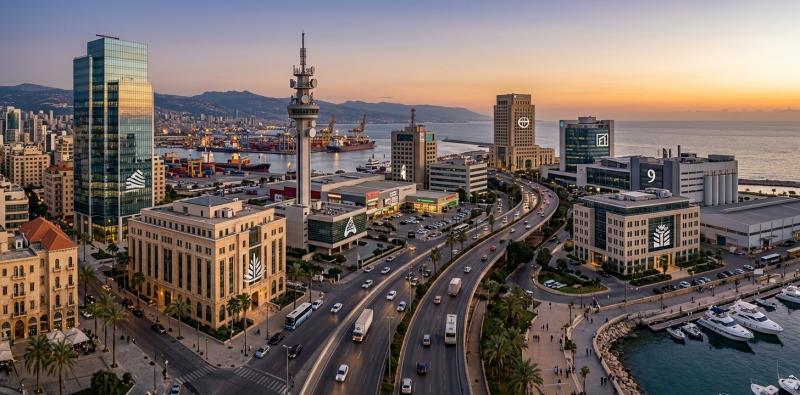
Lebanon's economy hosts a collection of companies that have established a presence far beyond its borders. Many major groups rely on markets in the Gulf, Africa, Europe, and the United States alongside their domestic operations.
The challenge lies in the fact that a significant portion of Lebanon's largest companies are privately owned and do not publish unified and up-to-date financial statements for direct comparison. The ranking of Lebanese companies depends on a mix of group size, global spread, assets, market power, and publicly available financial data.
Top 10 Companies in Lebanon
1. INDEVCO Group
INDEVCO Group leads as one of Lebanon's prominent industrial groups with a global presence. Founded in Lebanon, it operates in sectors like paper, packaging, plastics, consumer products, industrial materials, and renewable energy.
According to official data, the group is headquartered in Ajaltoun, employing over 9,900 staff with 38 factories and 38 trading firms in the Middle East, Africa, Europe, and the U.S., serving markets in about 90 countries.
This widespread reach grants INDEVCO an exceptional status among Lebanese companies, engaging in diverse industries linked to food, agriculture, healthcare, hygiene, construction, and logistics, making it one of the most diversified Lebanese groups.
2. Dar Group
Dar Group stands as a distinguished Lebanese success story in engineering consulting and design. Established in Beirut in 1956, the company transitioned into a global engineering firm involved in massive projects across transportation, energy, water, buildings, telecommunications, environment, and urban planning.
Published data indicates historical revenues of approximately $2.44 billion, with operations in numerous countries, and modern estimates suggest revenues of about $2.2 billion with over 10,000 employees, exemplifying a transition from a local company to a regional and global powerhouse.
3. AZADEA Group
AZADEA Group holds a prominent position in retail, fashion, and hospitality sectors in the region. It launched from Lebanon and built a vast network across the Middle East and North Africa.
The group manages a large portfolio of global brands in fashion, sports, beauty, food, and restaurants, strengthening its presence in shopping centers and regional markets. Its power is not only measured by its activity in Lebanon but by its capability to manage extensive retail operations across various countries.
4. Midis Group
Midis Group is recognized as a leading Lebanese name in technology and IT solutions distribution. It operates through specialized companies in software, hardware, technical infrastructure, and digital services with a broad regional and international presence.
Commercial databases show Midis Group in Beirut among internationally active companies. However, published revenue figures do not necessarily represent the entire group's consolidated revenues, thus it's preferable not to rely on a specific figure like $1.8 billion as an official 2026 revenue without published consolidated financial statements.
5. IPT PowerTech Group
IPT PowerTech merges telecommunications, energy, and technical infrastructure, expanding beyond the local market into multiple Middle Eastern and African markets. It specializes in telecom infrastructure solutions, data centers, power, and backup systems, vital with the rapid expansion of mobile networks and data centers.
Company databases indicate the presence of IPT PowerTech entities in Lebanon, yet published numbers vary depending on the legal entity measured, preventing a global group revenue total.
6. Khatib & Alami
Khatib & Alami is renowned for its consultancy and engineering services, founded in Lebanon and growing into an international entity. The firm offers design, consulting, engineering, project management, urban planning, and surveying, among other specialized services.
Commercial databases suggest the firm's global revenues are in the hundreds of millions, with broader estimates reflecting the difficulty in obtaining a unified figure for this multi-market private company. Therefore, its operations, expansion, workforce, and projects hold more significance than any single revenue estimate.
7. Solidere
Solidere differs from most companies as it is listed on the Beirut Stock Exchange, directly linked to the development and management of a crucial part of downtown Beirut. The firm owns a large real estate portfolio including land, properties, and projects in central Beirut.
Beirut Stock Exchange data notes the company's capital at $1.65 billion nominal value, with 165 million shares of A and B categories. Real estate shares dominated the market value on the Beirut Stock Exchange in early 2026, reflecting Solidere's weight in the Lebanese market.
It's crucial to differentiate between market value and actual economic value, especially amid Lebanon’s market conditions and currency dealings.
8. Bank Audi
Bank Audi remains a key player among Lebanon's largest financial institutions, measured by assets, deposits, and banking presence. Group data shows Bank Audi's consolidated assets at the end of June 2026 reached LBP 1,308,314 billion, with customer deposits at LBP 1,109,687 billion, and 38 branches in Lebanon, with presence in Saudi Arabia, Qatar, Abu Dhabi, and other markets.
In 2025, the bank reported a net profit of LBP 7,404.7 billion according to audited financial data published in 2026 while addressing the financial crisis repercussions and restructuring. Therefore, Bank Audi remains one of Lebanon's top companies based on assets and banking reach rather than just operational revenues.
9. BLOM Bank
BLOM Bank is also among Lebanon's largest banking institutions by assets and deposits, with local activity and subsidiaries in several foreign markets. Unverified results for Q2 2026 showed group assets around $18.17 billion and customer deposits around $16.06 billion.
The bank recorded a net income of $125.55 million during the quarter, highlighting its size compared to most firms in the Lebanese market, albeit comparisons between banks and industrial firms require different metrics owing to banking's nature.
10. CC Energy Development
CC Energy Development operates in oil, gas, exploration, and production, distinguishing it from most other names on the list. The company is associated with energy sector operations and projects in the Middle East and North Africa.
However, caution is necessary with revenue estimates found on some sites, as company databases show different numbers for the Beirut-registered entity, not necessarily representing the global group's size. For example, Dun & Bradstreet data presents limited figures for CC Energy Development in Beirut, highlighting why local entity revenue should not be converted into the entire group's revenues.
Why Is It Difficult to Rank the Largest Lebanese Companies by Revenue?
The difficulty in accurately ranking Lebanese companies financially stems from the nature of the Lebanese economy, where many top Lebanese groups are private companies operating across numerous countries, not publishing unified financial statements for the public like listed companies do.
Additionally, company registration methods differ among holding companies, subsidiaries, registered entities in Lebanon, and offshore companies. Thus, commercial databases may reflect revenues for a single Lebanese entity rather than the total global group revenues.
This is evident in data from Midis, IPT PowerTech, and other groups comprising multiple legal entities. Comparisons become more complex involving banks and real estate companies in the ranking since assets and market value are more indicative than traditional revenues in these sectors.
What Sectors Drive Lebanon's Largest Companies?
The list reveals Lebanon's corporate strength isn't concentrated in a single sector. Industries like packaging and manufacturing are significant with INDEVCO, while engineering and consultancy dominate firms like Dar and Khatib & Alami. Retail is strongly represented by AZADEA, whereas technology and digital infrastructure sectors are led by Midis and IPT PowerTech.
The financial sector retains a significant portion through Bank Audi and BLOM Bank, while Solidere represents the real estate, and CC Energy stands for the energy sector. This diversity shows Lebanon's prominent companies have built business models with varying degrees of reliance on external markets, crucial for lessening dependence solely on the domestic economy.
Ultimately, Lebanon's top 10 companies list shows the persistence of Lebanese economic groups with significant regional and global presence despite the deep financial crisis beginning in 2019.
However, any rankings of Lebanese companies should be approached cautiously, since the lack of a unified official database for revenues makes it challenging to definitively claim a company as the 'largest.' The focus should be on revenues, assets, international reach, employee numbers, market value, and project scale as a set of indicators to identify the most influential companies.
See Also
Best Arab Economies Globally