


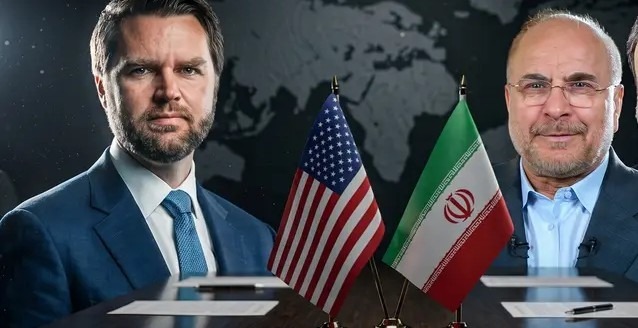
Despite the optimistic atmosphere surrounding the Iran-U.S. talks held at the Bürgenstock resort late Sunday into Monday, inconsistencies have surfaced through statements from Iran's chief negotiator Mohammad Baqer Qalibaf and U.S. Vice President JD Vance, who led his country's delegation.
Vance stated to the press that the U.S. agreed to release certain Iranian funds on the condition that progress is seen in negotiations between the two sides. He added that this move would benefit American farmers, hinting that American products would be purchased with those funds.
American President Donald Trump emphasized that Iran would buy American products with the released funds.
However, the Iranian side disputed this, with Qalibaf and Central Bank Governor Abdolnaser Hemmati asserting that Iran is not obliged to purchase agricultural products from the U.S. under the memorandum of understanding.
Hemmati rejected Trump's and Vance's claims, explaining that the first installment of $6 billion of the released Iranian funds would be used as per the 2023 prisoner exchange agreement between the U.S. and Iran, which restricts spending to essential goods and medicines.
He added that Iran would buy U.S. agricultural products only if they offered better prices and quality than alternatives, noting that the agriculture ministry has generally relied on major American and European companies in recent years for agricultural purchases.
Furthermore, the remaining frozen assets, including the second flight of $6 billion and all other withheld funds, would not be limited to basic goods and could be used to purchase non-sanctioned items.
Iranian Withdrawal
The second contradiction arose when Vance dismissed reports of the Iranian delegation's withdrawal from the 18-hour-long talks Sunday night into Monday as false news.
However, Qalibaf later claimed in a press statement that his delegation did indeed step out of the negotiations, which were nearing conclusion after lengthy discussions, due to Trump's threats and incendiary remarks about Iran. He mentioned informing the Qatari and Pakistani mediators that the first clause of the understanding prohibited exchanging threats between the countries, as reported by Iranian television.
Nuclear Inspectors
Vance said that Tehran agreed to allow entry for nuclear inspectors. He told journalists after participating in the talks, "We have laid a very solid foundation for a successful final agreement."
Nonetheless, Iranian foreign ministry spokesman Ismail Baqai reiterated that nuclear issues had not yet been discussed and no new commitments had been made during the Switzerland talks. He stressed that Iran's implementation of its obligations under the "Islamabad" understanding remains tied to the other party's commitments to ending the conflict, continuing Iranian oil exports, and releasing frozen assets and funds.
Notably, the Iranian delegation, led by Chairman of the Parliament Mohammad Baqer Qalibaf and Foreign Minister Abbas Araghchi, left the alpine resort after "18 hours of intense discussions," according to the official Iranian news agency (IRNA).
Meanwhile, Qatari Foreign Minister Sheikh Mohammed bin Abdulrahman Al Thani posted a photo early Monday showing him with Vance working on a laptop, with U.S. envoy Jared Kushner in the background. The caption read, "Live from Lucerne (Switzerland), work continues."
With the departure of both the American and Iranian delegations, the Swiss foreign ministry considered conditions were right for an "immediate resumption" of talks at a "technical" level.
Moreover, Iran and the United States reached an understanding during the talks on mechanisms to halt hostilities in Lebanon and secure the strategic Strait of Hormuz, as announced by mediating nations Pakistan and Qatar. These issues have been central to the ongoing regional conflict creating global economic disruptions. A joint statement from the Pakistani and Qatari governments noted "encouraging progress" from the negotiators.