


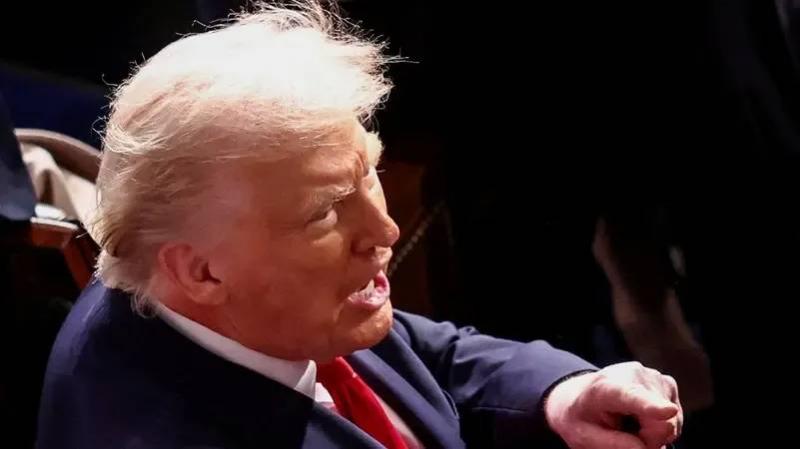
U.S. President Donald Trump has issued a stark warning to Iran, stating that continued violations of the ceasefire may prompt Washington to resume military action.
Speaking on Truth Social early Sunday, Trump declared, "If America resorts to the military option again, Iran will effectively cease to exist, and its actions could lead Washington to abandon rational behavior."
In a post on his account, Trump mentioned, "U.S. aircrafts have carried out airstrikes on sites storing Iranian missiles and drones, along with coastal radar locations, once again violating the ceasefire agreement! It's very unlikely they will ever learn," he observed.
Trump further warned that should the U.S. decide to escalate, Iran "will no longer exist," adding, "A time may come when logic fails us, and we are compelled to complete the mission successfully through military means. Should this happen, Iran will not remain."
Previously, the U.S. military stated it targeted Iran shortly after an assault on an oil tanker in the Strait of Hormuz, marking the worst escalation since a temporary peace deal.
The two countries have exchanged accusations of breaching the agreement made roughly two weeks ago to end a four-month-long conflict.
On Saturday, U.S. Central Command reported new strikes after a Panamanian-flagged tanker was attacked by an Iranian drone early Saturday. Meanwhile, Iranian state broadcaster IRIB reported hearing explosions in the southern Iranian city of Sirik early Sunday, without offering further details.
A Central Command statement noted Iran had the opportunity to adhere to the ceasefire agreement but chose not to. The strikes reportedly targeted Iranian military surveillance, communication, air defense, drone storage, and mine-laying facilities, in direct response to continued Iranian aggression on commercial navigation.
Later, Fox News quoted a U.S. defense official confirming that the strikes on Iranian targets were concluded.
Earlier, Washington announced night-time strikes on Iranian targets, while Iran claimed to have targeted U.S.-linked military sites on Saturday in retaliation.
The tanker was targeted Saturday in a move following an attack on a cargo ship Thursday, contributing to the latest escalation.
Iran attempted anew to assert control over the world's most crucial energy shipping channel, reopened in recent weeks after months of disruption.
Britain's Maritime Trade Operations said the Saturday-attacked tanker sustained damage to its bridge but the crew remained safe. The Combined Maritime Forces, a coalition safeguarding navigation, raised security threats due to recent events.
Iran has not directly commented on specific ship attacks. Nonetheless, Iranian state TV reported the Revolutionary Guard firing "warning shots" at unspecified ships using unauthorized routes through the strait, leading other ships to request Iranian permits for passage.
Previously, Iran's foreign ministry claimed to have executed "defensive" attacks on U.S.-linked military targets, while Bahrain, hosting the U.S. Fifth Fleet, reported an Iranian drone attack.
Iran asserts its control over the vital strait.
Both Israel and Lebanon have agreed on multiple U.S.-brokered ceasefires, most recently on Friday. Yet, these agreements have generally borne limited success, with Israel refusing to withdraw from occupied land and Hezbollah rebuffing disarmament calls while Israeli forces remain stationed in the south.
Lebanese state TV reported an Israeli drone strike Saturday in South Lebanon, which has seen Israeli strikes throughout the conflict. The Israeli army stated they targeted a person threatening their forces.
Hezbollah's Secretary General Naeem Qasem rejected the recent Israel-Lebanon deal as a surrender lacking "existence."
While hundreds of thousands of Lebanese, primarily Shiite, remain displaced from occupied areas, discontent over the agreement extends beyond Hezbollah to the broader Shiite community.
Israeli Defense Minister Yisrael Katz commended the agreement, asserting it allows Israel to maintain occupation of the so-called Lebanese security zone and prevent displaced residents' return.
Mohsen Rezaei, an advisor to Iran's Supreme Leader, argued Washington violated the war-ending memorandum by supporting regional proxies and inflaming tensions in Hormuz.
Iran has also attacked neighboring Gulf States hosting large U.S. military bases. Iranian state TV said the Revolutionary Guard issued a "firm response" after U.S. forces bombed a communications tower in the coastal city of Sirik. The Mehr News Agency reported the port operating normally with no reported facility or equipment damage.
Bahrain stated the latest Iranian attacks breached the memorandum of understanding.
Hundreds of vessels, including oil-laden tankers, have been trapped in the Gulf since the conflict's outset, but as they began exiting through the strait in recent weeks, oil prices have fallen near pre-war levels due to increased supply.
Washington promotes a southern route along the Omani coast, while Tehran wants vessels to follow a northern path through its waters, ultimately imposing tolls for the strait's use.
Iran's National Security and Foreign Policy Chairman Ebrahim Azizi affirmed Saturday that Iran would forcefully respond to any navigational violations across the strait.
U.S. Vice President J.D. Vance, Trump's lead conflict negotiator, stated Americans had upheld the ceasefire deal and Iran would bear any conflict resurgence responsibility due to its actions.
Vance tweeted on X, "Iran signed the ceasefire agreement. We've adhered to it. If they have objections on the memorandum's implementation, they can call us. But violence will meet violence."