


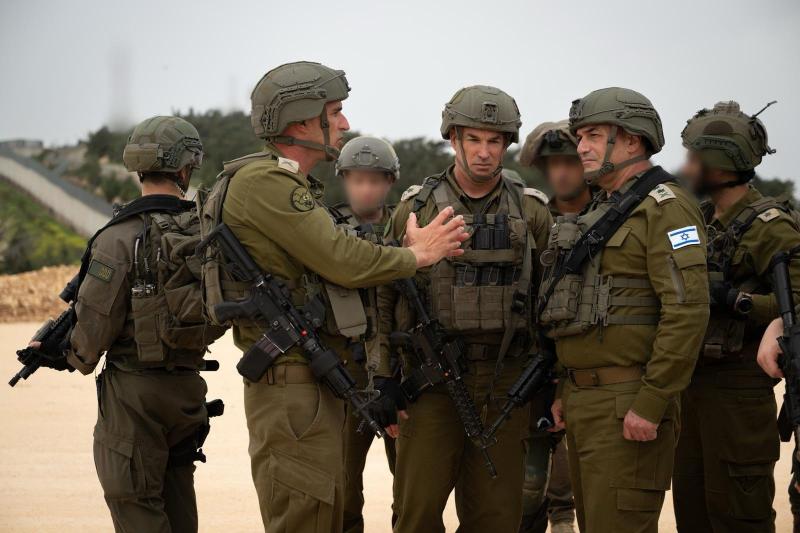
The Israeli army has disclosed details of operations deep inside southern Lebanon, aimed at dismantling Hezbollah's military infrastructure. The operations lead to the discovery of significant stockpiles of weapons, the elimination of a militant cell, and the uncovering of an underground command center beneath a concrete plant, which was subsequently destroyed with large quantities of explosives.
According to a report by journalist Hillel Biton Rosen on 'Channel 14' in Israel, a media team accompanied soldiers from the 601st Battalion of the Engineering Corps, which operates under the 401st Brigade, in areas described as the furthest point reached by Israeli forces - 11 kilometers from the border after the town of Beit Yahoun.
A soldier was quoted saying, "The enemy is here, they aren't here to play with us. When we wake in the morning and look back at our towns, we understand the importance of us being here."
During the patrol, the forces entered a house in the area. Lieutenant Colonel "Y," commander of the 601st Battalion, mentioned finding large amounts of weapons used by Hezbollah militants.
"We're inside a house where we've found a very large quantity of weapons, and Hezbollah operatives had been staying here before our arrival. Every day we find weapons aimed at Israel, whether they are long-range, medium-range missiles, or anti-tank missiles directed at areas where Israeli army forces are maneuvering right now. Our presence here is defensive, and in my view, it's an honor," he added.
The report highlighted that a few days ago, Israeli forces killed a militant cell in the area. Major "R," a company commander in the 601st Battalion, stated, "During one of the raids in recent days, a sniper spotted three militants, after which the observation and attack system started operating, and within minutes, a 'Zik' drone was targeting them."
The primary mission for the engineering forces is identifying and destroying the infrastructure established by Hezbollah in southern Lebanon over the years. Captain "J," commander of the engineering company in the 601st Battalion, said, "Our mission is ultimately to demolish the existing infrastructure here. The longer the time we have, the more infrastructure we destroy. In my opinion, Hezbollah operatives recognize this as they attempt, whether there is an agreement or not, to return to these areas to disrupt our work. We find high-quality, costly weapons and destroy them, which harms them directly."
In the Beit Yahoun area, forces also reached a seemingly normal civilian concrete factory, yet the Israeli military claimed it had discovered an underground infrastructure below, serving as a critical command center for Hezbollah.
Captain "Y," commander of the engineering vehicles company within the 601st Battalion, stated, "I'm taking you now to underground infrastructure we discovered here, which was basically a command post we reached from intelligence. This was a place previously attacked but remained intact, and we found everything inside, from computers to weapons." When asked by a Channel 14 reporter about the future of the site, Captain "Y" answered: "We'll destroy it. We'll destroy it with dozens of tons of explosive materials we'll bring today, and any terrorist infrastructure here won't remain. Anything threatening the citizens of Israel, we'll leave as scorched earth."
Later that night, the infrastructure was destroyed in a massive explosion, as part of what the Israeli army described as efforts to uncover and dismantle Hezbollah's military system in southern Lebanon.
Major "B," deputy commander of the 601st Battalion, remarked, "At first, we reached a collapsed entrance to the tunnel path, assessed the situation again, and reached a second entrance leading us inside the path and into the infrastructure, providing additional motivation to continue destroying enemy installations and advancing in the region."
The report notes that the battalion commander assumed his role at the beginning of the conflict, following the death of Deputy Battalion Commander Major David Shkuri in northern Gaza.
Lieutenant Colonel "Y" stated, "I've known David since we were company commanders together in this battalion, and I'm sure this is what he would want from us, and also what was wanted by his wife and family."
The report also addressed concerns about the Israeli forces' exhaustion and capability, asking a soldier, "What do you say to those who claim you’re too tired and drained to fight?" The soldier responded, "We are here to defend the state; this is our true mission, representing the entire population. There is no such thing as tired... what tiredness? We've only just begun."
During the visit, Reserve Lieutenant Colonel Shalom Eisner, Deputy Commander of the 401st Brigade, addressed saying, "We are here to stay and prevent threats to the towns. I always remember the song lyrics "There are now cannons on the hill threatening Damascus. I want the people here to live without direct threat and without the fear of anti-tank missiles on towns; that's why we are here."
The report reflects the Israeli narrative regarding the ongoing military operations deep within southern Lebanon, as Tel Aviv asserts its continued targeting of Hezbollah's military infrastructure and the removal of perceived threats along its border.
Israeli Military Reveals Deep Deployment in Southern Lebanon Targeting Hezbollah
Share