


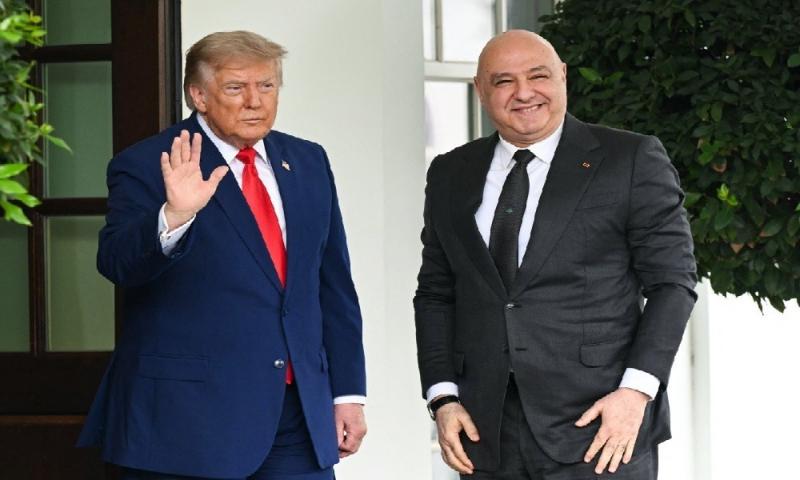
The ongoing crisis in Lebanon has entered a new phase, intersecting security and political dynamics as the implementation of the framework agreement for Southern Lebanon begins. This development coincides with Lebanese President Joseph Aoun's visit to Washington, where he met with U.S. President Donald Trump. This move is seen as a practical test of Lebanon's ability to assert sovereignty in the south.
The Lebanese Army announced its deployment in 'experimental areas,' while President Aoun stated that extending state sovereignty and disarming Hezbollah is achievable. However, this goal relies on the complete Israeli withdrawal from Lebanese territories, strengthening army capabilities, and launching a state-led reconstruction initiative.
Analysts and experts from the U.S. and Lebanon told 'Sky News Arabia' that success hinges on Lebanon's ability to balance the Israeli withdrawal with empowering the army to impose authority and resolving the Hezbollah weapon issue without internal conflict.
During the final day of his U.S. visit, President Aoun emphasized that Hezbollah's disarmament cannot be separated from its origination causes. He noted that disarmament is possible if handled with sincerity, beginning with ending the Israeli occupation, and transitioning operational control exclusively to the Lebanese Army, necessitating unconditional support for the military as the sole legitimate defense force.
As part of the framework agreement's implementation, the army deployed in the town of Western Zawtar, one of three 'experimental' areas, alongside Faron and Srifa. This action is part of a process involving gradual Israeli withdrawal, Lebanese army deployment, and preventing any military presence outside state institutions, paving the way for expansion to other southern areas.
Tensions arose during the deployment as Lebanese forces reported receiving fire from the Israeli side during their mission. The Israeli army claimed to have fired warning shots after Lebanese personnel entered a zone said to be outside the agreed experimental area.
This process faces significant challenges with Hezbollah's refusal to disarm and its opposition to direct negotiations between Beirut and Tel Aviv, making the agreement's success contingent on Lebanon fulfilling its security commitments, ensuring complete Israeli withdrawal, and avoiding internal conflict.
Lebanese military expert and geopolitical academic General Naji Malaybi indicated that the implementation of the experimental areas in the south was anticipated, especially as it aligned with President Aoun's visit to the U.S. He suggested that Israel attempted to delay the process by questioning the Lebanese army's readiness.
Malaybi told 'Sky News Arabia' that the Lebanese army's demonstrated readiness paved the way for initiating the experimental phase. Prime Minister Nawaf Salam's visit to a town from which Israeli forces withdrew reflected the Lebanese state's commitment to achieving complete southern liberation, enabling the return of displaced people and reconstruction initiation.
The Lebanese optimism, Malaybi added, is rooted in the heightened American focus on Lebanon. President Aoun utilized Washington meetings to present Lebanon's vision to U.S. decision-makers, asserting that Washington may exert pressure on Israel to complete its withdrawal, given Lebanon's commitment to halting hostilities with Israel and engaging in a negotiation process aimed at stabilizing the region.
Malaybi noted that completing the Israeli withdrawal would facilitate the removal of illegal arms in the south, with the Lebanese army assuming responsibility for deployment, potentially in collaboration with the United Nations Interim Force in Lebanon (UNIFIL) or a European force. The state could then address disarmament across Lebanese territories, cementing its control over war and peace decisions.
Regarding Hezbollah, Malaybi stated that some party leaders welcomed the Lebanese army replacing Israeli forces in the evacuated areas, though the final decision depends on Iran, due to their political, military, and financial ties. While Hezbollah strives to maintain its role in future political arrangements, Malaybi emphasized that Lebanon's core issue extends beyond Hezbollah's arms to its dominance over state institutions.
He confirmed that the Lebanese government’s plan and complete Israeli withdrawal would lead to a new Lebanon, where the state alone controls war and peace decisions, ending Hezbollah's dominance over internal affairs.
Matthew Levitt, Director of the Anti-Terrorism and Intelligence Program at the Washington Institute for Near East Policy, highlighted that the agreement between Beirut and Tel Aviv focuses on execution and verification mechanisms. It outlines successive actions aimed at Hezbollah's disarmament, enabling the Lebanese Army to reclaim full sovereign control of all Lebanese territories, culminating in the eventual redeployment and withdrawal of Israeli forces.
Levitt added that the agreement's execution features several notable aspects, chiefly Iran's absence as a primary actor. Despite Hezbollah testing the memorandum's limits, Tehran is expected to continue supporting its proxy and undermining the accord, underscoring the need for a plan to verify the disarmament of Hezbollah and other non-state armed groups in Lebanon.
Executing the Lebanese army's deployment mission will require close intelligence cooperation among parties and extensive U.S. and partner support, Levitt noted. The agreement's requirements mark a crucial shift from the November 2024 ceasefire, when the Lebanese army failed to effectively disarm Hezbollah despite its efforts.
Levitt observed that the current agreement's success won't be measured by the Lebanese army's mere deployment, but by its ability to dismantle Hezbollah's military capabilities, including arms stored in homes and properties, tunnels, and weapon and funding networks.
American expert on security and strategic affairs, Irina Tsukerman, explained that Trump's statements signify Washington's intent to showcase diplomatic progress in Southern Lebanon. However, it does not indicate a substantial policy shift towards Beirut or Israel.
Tsukerman clarified that the U.S. administration might support limited Israeli withdrawal concurrent with Lebanese army deployment and security arrangements completion, but it appears unprepared to impose real pressure obliging Israel to a full withdrawal from Lebanese territories still occupied.
She added that Washington continues to adhere to Israel's viewpoint, associating withdrawal with improved security, including Hezbollah's arms, granting Israel leeway to justify its military presence. Any action by Trump would be restricted to encouraging gradual steps marketed as diplomatic success, rather than imposing deadlines or sanctions or military aid restrictions on Israel.