


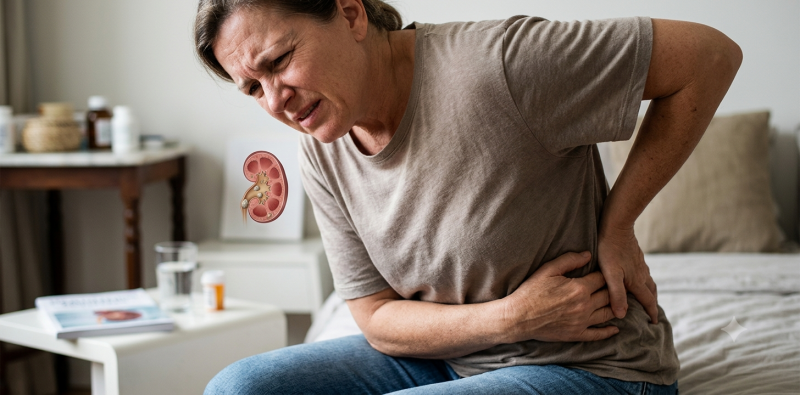
Kidney deposits or accumulated salts can be one of the causes of lower back pain. However, this is not always the case. In the early stages, the affected person may not experience any symptoms, with pain beginning to appear when the deposits move or turn into small stones, obstructing urine flow or irritating the urinary tract.
Many people think that any back pain indicates a kidney problem. However, the reality is different, with clear differences between kidney pain and muscle or spinal pain. A doctor can determine the cause following a physical examination and necessary tests.
What Are Kidney Deposits?
Kidney deposits are clusters of salts and minerals that accumulate inside the kidneys due to increased concentration of certain substances in the urine, such as calcium, uric acid, or oxalate. Over time, these crystals can stick together to form stones of varying sizes.
Often, small deposits pass through urine without causing any issues. But if they become larger or move within the ureter, they can lead to severe pain and clear urinary symptoms requiring treatment.
How Do Kidney Deposits Cause Lower Back Pain?
When the deposits remain in the kidney without obstructing urine flow, the person may not feel any pain. But once they move towards the ureter or cause a partial blockage, pressure within the kidney rises, leading to the onset of a pain known as renal colic.
Additionally, the friction caused by the stones against the lining of the urinary tract can lead to inflammation and irritation, intensifying the pain and making symptoms more noticeable.

Characteristics of Back Pain Caused by Kidney Deposits
Recognizing the characteristics of the pain helps distinguish between kidney and other types of back pain.
Pain Location
Pain is usually concentrated in one of the flanks below the ribs, either on the right or left side, and may spread to the lower back depending on the stone's location.
Nature of the Pain
The pain is characterized as sharp and sudden, occurring in waves or frequent episodes, with intensity increasing for several minutes before briefly subsiding, making it one of the most intense types of pain.
Pain Spread
Apart from the flank area, the pain may extend to the lower abdomen, pelvis, or thigh, especially if the stone moves within the ureter.
Movement Independence
A distinctive sign of kidney pain is that it doesn't improve with body position changes. The pain remains the same whether the patient sits, stands, or lies down, unlike muscle pain, which often improves with rest or position changes.
Differences Between Kidney Pain and Muscle Pain in the Lower Back
Patients often confuse the two, but certain signs help differentiate them.
Kidney Pain
-Appears in one of the flanks below the ribs.
-Is sharp or colic-like.
-May extend to the abdomen or thigh.
-Does not change with movement.
-Often accompanied by urinary symptoms.
Muscle Pain
-Concentrated in the middle or lower back.
-Increases with movement or weight lifting.
-Improves with rest or warm compresses.
-Not accompanied by changes in urine or urinary symptoms.
Symptoms Indicating that Pain Is Related to Kidney Deposits
If back pain is due to kidney deposits or stones, several other signs may appear, including:
-Burning sensation or pain during urination.
-Frequent urination or an urgent need to urinate.
-Cloudy or dark-colored urine.
-Presence of blood in the urine.
-Nausea or vomiting.
-Fever in case of accompanying infection.
-Reduced urine output in case of severe blockage.
Additionally, some patients may experience intermittent pain increasing gradually as the stone moves within the urinary system.
When Is Back Pain a Sign to See a Doctor?
Although some cases may improve on their own, some symptoms should not be ignored as they may indicate a blockage or infection needing urgent treatment.
These include persistent pain lasting hours, non-responsive to painkillers, visible blood in the urine, high fever, chills, and difficulty or cessation of urination. Delaying treatment could lead to kidney damage or spread of infection.
How Is Kidney Deposits Diagnosis Made?
The diagnosis is based on medical history and physical examination, followed by tests to accurately determine the cause.
Urine Test
Helps detect the presence of blood, pus, excessive salts, or signs of infection.
Blood Tests
Used to assess kidney function and measure levels of calcium, uric acid, and other minerals.
Ultrasound
One of the most used tests to detect stones and assess obstruction within the kidneys.
CT Scan
Is the most accurate for diagnosing kidney stones, especially small ones or those hard to detect by other means.

Treatment for Kidney Deposits and Lower Back Pain
Treatment depends on the size, location, and severity of the symptoms of the deposits.
Drinking Adequate Water
Increasing water intake is the first step in helping to expel small deposits and preventing increased salt concentration in the urine.
Medications
A doctor may prescribe painkillers and medications to relax the ureter, facilitating the expulsion of small stones, along with antibiotics if there is an infection.
Stone Fragmentation
If stones are large or do not pass on their own, shock wave lithotripsy or an endoscope may be used as evaluated by a doctor.
Surgical Intervention
In large or complex cases, surgery may be the best option to remove stones and preserve kidney function.
Can Kidney Deposits Be Prevented?
Yes, and the risk of developing them can be significantly reduced by adopting some healthy habits.
Key Prevention Methods
-Drink enough water daily.
-Reduce salt intake.
-Moderate animal protein consumption.
-Limit sugary carbonated drinks.
-Maintain a healthy weight.
Does All Lower Back Pain Mean Kidney Deposits?
No, lower back pain is among the most common symptoms and may result from muscle strain, slipped disc, joint problems, spinal issues, or even some gastrointestinal diseases. Therefore, pain alone cannot diagnose kidney deposits; other symptoms must be evaluated, and appropriate tests conducted.
In conclusion, kidney deposits can cause lower back pain, but they are not the only cause of this type of pain. Therefore, persistent pain, fever, or blood in the urine necessitates a quick doctor visit for proper diagnosis and treatment before complications arise. Ensure adequate water intake and follow a healthy lifestyle for kidney health.