


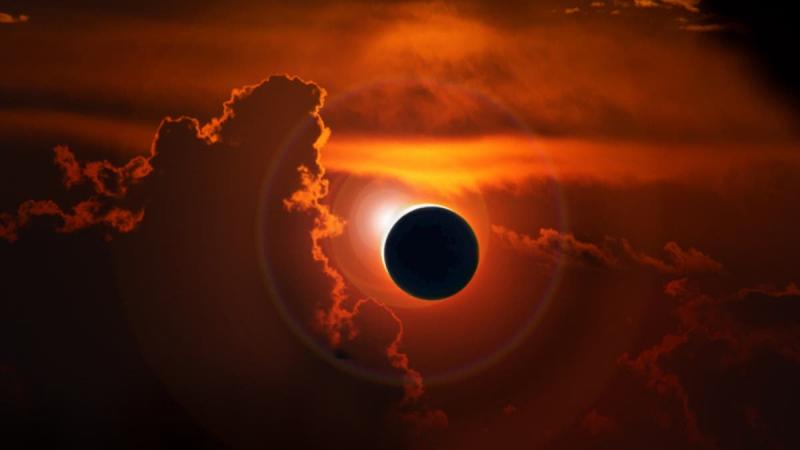
In a much-anticipated event, the skies over Spanish and Portuguese cities became a mesmerizing scene on Wednesday as the moon eclipsed the sun, creating an extraordinary astronomical phenomenon that drew massive crowds of locals, tourists, and astronomy enthusiasts.
As the eclipse approached, many people paused in streets, squares, and fields, lifting their protective glasses toward the sky. Within moments, daylight dimmed quickly, and the moon's shadow obscured the sun, leaving its corona visible. Cheers and applause erupted from the audience.
In the Spanish town of Medinaceli, open fields transformed into natural viewing stands for thousands of visitors, some arriving hours early, equipped with chairs, cameras, and telescopes. Others traveled long distances from the United States, Japan, and Europe to witness this rare event.
The eclipse's totality path stretched from Greenland and Iceland, across the Atlantic, to northern, central, and eastern Spain, ending over the Mediterranean near the Balearic Islands. Meanwhile, parts of Europe and North Africa experienced varying degrees of a partial eclipse.
Several Spanish cities, including Bilbao, Burgos, Leon, Zaragoza, and Valencia, were plunged into darkness lasting from seconds to nearly two minutes. In contrast, Madrid and Barcelona narrowly missed the total eclipse despite more than 99% of the sun being obscured.
In Portugal, a partial eclipse was visible across most of the country, with a small area in the far northeast near Montesinho Park in Braganca experiencing brief totality.
The timing of the event, shortly before sunset, added to its uniqueness, with the moon appearing low on the horizon and surrounded by a white corona, as the sky took on sunset hues. Spanish media described the scene as akin to 'two nights in one day.'
The eclipse brought an abrupt decrease in light and temperature, causing noticeable changes in some birds and animals, which reacted as if night had fallen.
Social media quickly filled with photos and videos capturing the phenomenon, especially the 'diamond ring' effect, when a bright point of sunlight remains at the moon's edge just before complete coverage.
Videos showed crowds cheering as the light returned, with some viewers describing the experience as 'the longest and shortest minute' of their lives, noting that photos couldn't capture the startling change in light, temperature, and the silence before the excitement.
Other videos documented street lights activating automatically, birds returning to roost, and squares momentarily sinking into darkness before sunlight reappeared.
Spain prepared for the event by establishing around 350 official viewing sites, alongside extensive security and emergency measures amid concerns about a heatwave and wildfire risks in arid rural areas.
European reports estimated approximately six million people witnessed the eclipse path in Spain, including many tourists. Accommodation prices soared in some rural towns, and eclipse viewing glasses sold out in many stores days ahead of the event.
Astronomy centers saw large gatherings, where scientists explained the stages of coverage and the appearance of the solar corona and prominences during the total eclipse.
In Iceland, the event marked a historic moment for Reykjavik, despite clouds obscuring the view in some areas. Residents of the UK, France, Ireland, and Italy observed a significant partial eclipse.
This Wednesday's eclipse marks the beginning of an extraordinary series of eclipses in the Iberian Peninsula. Spain is set to witness another total eclipse in August 2027, passing through the south of the country, followed by an annular eclipse in January 2028.
For millions gathered under the moon's shadow, the spectacle surpassed astronomical calculations and figures; in moments, sunlight vanished, city sounds hushed, and the first beam of light restored life to streets and squares.