


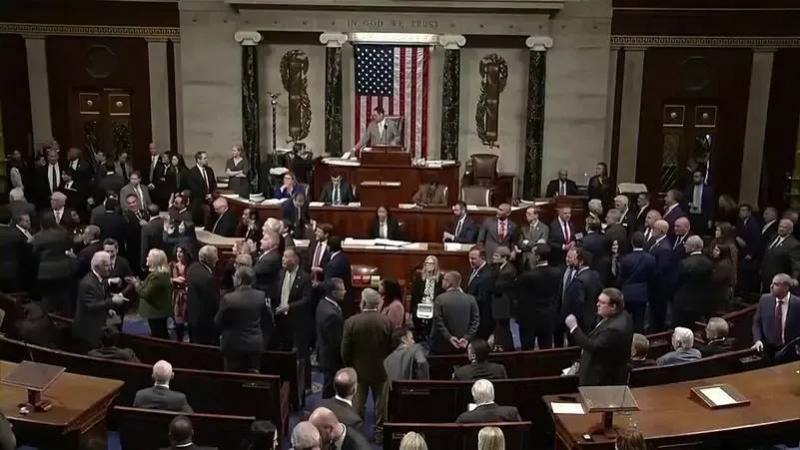
As the US midterm elections approach this November, there's a growing focus on the American conflict with Iran as a key election issue for the Democratic Party. They're attempting to redirect the conversation from Middle Eastern strategies and nuclear issues to domestic concerns like gasoline prices, cost of living, and military expenditure.
Increasing Pressure and Declining Popularity
This development comes with less than 80 days to the elections, as President Donald Trump and the Republican Party face mounting economic pressures.
On Monday, a new poll by Reuters/Ipsos revealed a drop in Trump's approval rating to its lowest since he returned to the White House, with rising American anxiety over prolonging the war with Iran.
Only 33% of respondents approved of Trump's performance, while 64% disapproved. This is down from 35% in a poll earlier in August.
This new figure matches Trump's lowest approval during his first term, when it hit 33% in December 2017.
From Nuclear Issues to War Costs
Democrats aim to reframe the conflict as an economic issue at home, not just a security matter.
In this context, gasoline prices and inflation have become prime political tools to connect the war to voters' everyday lives.
According to Reuters, the average gasoline price in the US surpassed $4 per gallon, reaching around $4.06 in mid-August and nearing $5.50 in states like California and Hawaii.
Economic reports have linked this hike to the war's impacts, such as disrupted oil supplies via the Strait of Hormuz and general inflationary pressures affecting food, transportation, and energy prices.
The US administration has acknowledged that soaring fuel costs present a direct political challenge ahead of the elections.
Schumer and Jeffries: War as a Living Cost
Democratic leaders argue the war has directly impacted the American economy, with increasing rhetoric linking military operations to daily living expenses.
Senate Democratic Leader Chuck Schumer described the memorandum of understanding with Iran as a "complete and utter failure" that didn't achieve its stated goals and pushed gasoline prices above $4 per gallon.
He called it "one of the biggest foreign policy disasters in American history," asserting Trump "weakened troops and the nation," and urged immediate diplomatic efforts to end the war.
Similarly, House Minority Leader Hakeem Jeffries stated that "Trump's reckless chosen war in Iran" raises gasoline prices, urging continued pressure to end the conflict.
On August 15, he labeled it "enough of the Republicans' failed chosen war in Iran," referencing conditions aboard the USS Abraham Lincoln carrier.
The Global Scene: US and Trump Following reports on the carrier crew's conditions... CENTCOM Commander: My visit to "Lincoln" was inspiring
Democratic Senator Jacky Rosen noted that gas prices take longer than usual to decrease due to Trump's war in Iran, pointing out that prices in Nevada exceed the national average and calling for an end to the war to lower family costs.
Ossoff: Accusations and Contradictions in War Management
In Georgia, Democratic Senator Jon Ossoff used harsher rhetoric at an Atlanta campaign rally on August 16-17, 2026, accusing Trump and Defense Secretary Pete Hegseth of "lying to the nation to drive it into war," describing the conflict management as "uniquely depraved."
Ossoff outlined what he sees as contradictions in the administration's narrative: from previous claims of destroying Iran's nuclear program to talks of an imminent threat, then declaring victory on day four, while the war has continued for 170 days with Iran retaining uranium and the Strait of Hormuz remaining closed.
He also criticized conditions aboard the USS Abraham Lincoln, which has spent more than 240 days at sea without a port stop.
The war for Democrats pulls several issues into a singular campaign message: gas prices surpassing $4 a gallon, inflation, rising living costs, and long-term military spending.
House Foreign Affairs Committee Democrats criticized Trump's decision to scale down joint military exercises with South Korea, citing Seoul's refusal to assist in his "illegal war" in Iran, arguing it weakens a 70-year-old alliance and makes America less secure.
Republicans Face a Tough Equation
Republicans, on the other hand, defend the war as a security necessity to prevent Iran from acquiring a nuclear weapon. Yet, the continued rise in fuel prices presents a political dilemma, as the connection between the war and living costs increasingly impacts voters.
Republican Senator Jim Justice stated, "The situation in Iran causes unimaginable repercussions," adding, "I truly believe that once we decided to go, we must win."
He also noted the USS Abraham Lincoln's record duration at sea.
Trump has warned that soaring gas prices could be a necessary price for the conflict, even as prices eclipse $4 per gallon.
November Elections Will Decide the Impact's Scale
Although the war isn't the only factor in the elections, it offers Democrats a chance to combine economic, inflation, and living cost concerns into a single narrative. The party has expanded its election targeting map by adding 12 new Republican districts, bringing the total to 58, according to the Associated Press.
Democrats aim to present the war on Iran as a direct economic burden on American citizens, while Republicans try to portray it as a security necessity.
Amid these narratives, voters remain the ultimate arbiters, as seen in their daily experiences with fuel prices, living costs, and tax burdens linked to a seemingly endless war.