


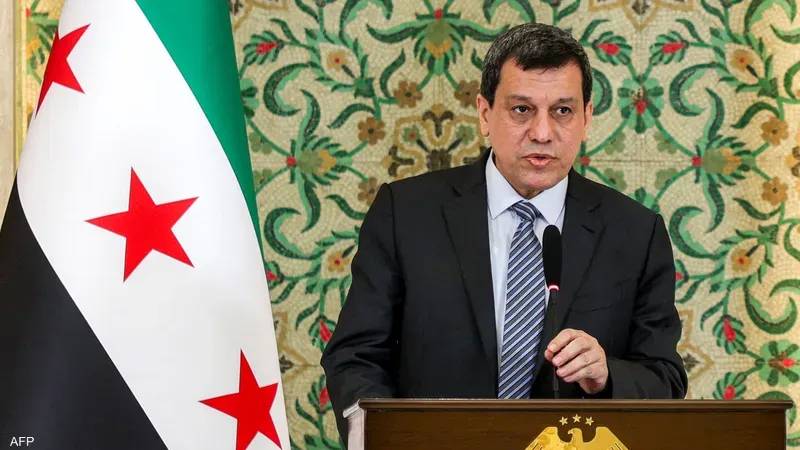
Mazin Abdi has undergone a swift transition from leading an independent military force to holding an official position within the Syrian presidency. On August 25, 2026, the dissolution of the Syrian Democratic Forces (SDF) was announced following its full integration into state institutions. Two days later, President Ahmad Al-Shara issued Decree No. 164 of 2026, appointing Mustafa Khalil Abdi, known as "Mazin Abdi," as an advisor to the presidency, according to the Syrian Arab News Agency (SANA).
This appointment marks the end of an era spanning over a decade during which Mazin Abdi led the most prominent force in northeastern Syria and became a crucial field partner for Washington in the fight against ISIS. Meanwhile, he remained a sought-after figure by Ankara.
Multiple Names and Early Path
Abdi was born in 1967 in the region of Ayn al-Arab "Kobani," near the Syrian-Turkish border, and studied engineering at the University of Aleppo before joining the Kurdish armed movement in the early 1990s.
Throughout his career, he has been known by various names. The Syrian decree refers to him as "Mustafa Khalil Abdi," while other sources identify him as Farhad Abdi Shahin. He has also been known as "Mazin Kobani" and "Shahin Jilo" during his military activities.
Abdi joined the Kurdistan Workers’ Party (PKK) in the early 1990s and was close to its founder Abdullah Ocalan, according to research and media reports. He was active in Turkey, faced arrests in Syria, and eventually moved to Europe and then northern Iraq.
With the onset of the Syrian war in 2011, Abdi returned to his homeland, contributing to the establishment of the "People’s Protection Units."
Kobani: The Making of a Leader
Abdi’s name rose to prominence during the Kobani battle from 2014 to 2015 when ISIS besieged the city and controlled large parts of it. With international coalition air support, Kurdish units fought on the ground until the militants were expelled.
The battle paved the way for the establishment of the "Syrian Democratic Forces" in October 2015, involving the People’s Protection Units, as well as Arab and Syriac factions, with the Kurdish units remaining its primary military backbone.
Abdi took on the general leadership of this new formation, which became the foremost ground ally for Washington in Syria. The SDF expanded its control in Raqqa, Deir ez-Zor, and Hasakah, leading to the fall of ISIS’s last territory in Baghouz in March 2019.
In the same year, SDF leadership said they participated with the US in intelligence operations tracking ISIS leader Abu Bakr al-Baghdadi, who was killed in a US operation in Idlib, according to Reuters.
Ally of Washington, Rival of Ankara
The US alliance placed Abdi at the center of a dispute between Washington and Ankara. While the US interacted with him as the leader of a partner force against ISIS, Turkey regarded the People’s Protection Units as an extension of the PKK, which it classifies as a terrorist organization along with the US and the European Union.
Ankara put Abdi on its wanted list and in 2019 demanded his arrest and extradition, claiming he was included in an Interpol red notice. Conversely, Abdi maintained that the SDF was a Syrian force not organizationally linked to the PKK.
After Ocalan called for the party to disarm and dissolve in February 2025, Abdi welcomed the move but emphasized it pertained to the party in Turkey and "did not concern them in Syria."
Balancing Act
During the war, Abdi managed intersecting relations; maintaining a military alliance with Washington, opening channels with Moscow, and keeping communication open with former President Bashar al-Assad’s government.
When Turkey launched a military operation in northeastern Syria in 2019 following a partial US troop withdrawal, Abdi consented to the deployment of Syrian and Russian forces in border regions, reflecting an adaptation of his alliances to battlefield realities.
However, Assad's fall in December 2024 altered the equation, with Damascus's new leadership demanding the dissolution of armed formations and the unification of the army. Initially, the SDF insisted on merging as an independent military bloc, which the government rejected.
On March 10, 2025, Abdi and Al-Shara signed a preliminary agreement to merge military and civilian institutions in northeastern Syria into the state. After months of negotiations and tension, the advance of government forces in early 2026 curtailed SDF control, leading to a gradual integration agreement reached in January.
From Weaponry to the Palace
On August 25, Abdi announced from the Presidential Palace the end of the SDF’s mission and its dissolution as an independent military force, affirming its integration into the Syrian army. Two days later, he assumed his advisory position through an official decree.
While the role does not grant him independent military power, it keeps him within the decision-making process and offers a platform to continue political work on Kurdish rights, providing Damascus with a figure capable of engaging a segment of the Kurdish community.
Thus, Abdi's journey from the ranks of the PKK to leading a US-backed force, and finally to an advisory role within the Syrian presidency, encapsulates the transformations of the war: shifting alliances, expanding and contracting influence, and a military leader ending his path as an advisor in Damascus.