


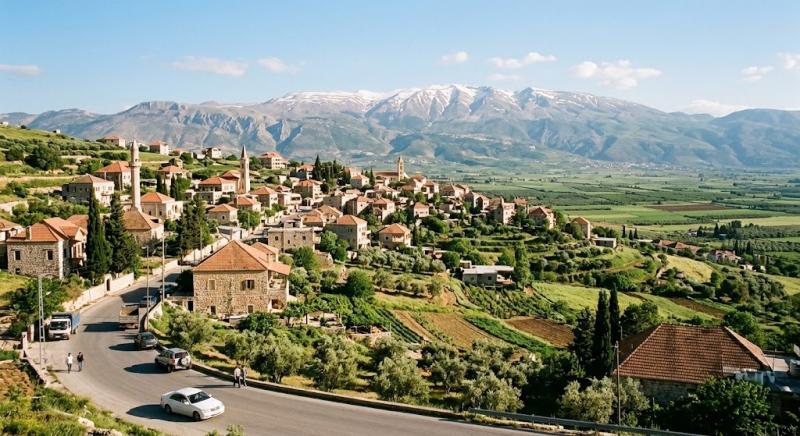
Joub Jannine is nestled in the West Bekaa district within Lebanon’s Bekaa Governorate. Serving as the administrative center of the district, it is situated approximately 68 kilometers from Beirut and stands at about 930 meters above sea level, encompassing an area of roughly 15.75 square kilometers.
Its central location in West Bekaa grants Joub Jannine a special significance, linking it with numerous towns and villages while lying within a region where agricultural lands, slopes, elevations, and waterways intertwine.
The town's importance is not solely geographical; historically, its position made it a critical junction for connecting various parts of the Bekaa Valley, especially with its historic bridge over the Litani River.
Why is Joub Jannine Important in West Bekaa?
Joub Jannine holds administrative and economic importance beyond its physical size, being the center of West Bekaa district. It houses several institutions providing services to both locals and neighboring villages.
Its central location has spurred commercial activity, making it a key hub for economic and service activities in the area. Historically, the town is also linked to agricultural pursuits, a mainstay of the West Bekaa's economy.
Local sources highlight numerous economic and service institutions in the town, alongside official, educational, health, and social establishments.
The Historical Journey of Joub Jannine
The history surrounding Joub Jannine dates back to ancient times and extends beyond Roman or Ottoman periods.
A notable archaeological site, Tell Jisser, located northwest of Joub Jannine, boasts layers dating back to prehistoric times, including the Neolithic and Chalcolithic ages, with evidence pointing to origins thousands of years BC.
Joub Jannine itself owed its historical prominence to its strategic position along movement routes within the Bekaa Valley, vital for agriculture, trade, and commuting.
The Historic Joub Jannine Bridge
The Joub Jannine bridge is a significant historical landmark of the town, deeply tied to its identity. Sitting over the Litani River to the town's west, it once played a crucial role in linking the eastern and western regions of the Bekaa Valley.
Historical and archaeological accounts trace the bridge back to Roman times, noting its multiple renovations and reconstructions over the years. More than just a passageway, it facilitated trade caravans transporting grains, agricultural goods, and merchandise.
Nearby is Tell Haimour, historically noted for monitoring caravan movements. Other sources indicate the bridge consisted of stone arches and underwent various damages and restorations due to floods and watercourse changes, recently revealing previously buried sections.
Today, the bridge stands as a testament to Joub Jannine's role in the history of trade and agriculture in the Bekaa region.
Joub Jannine and the Litani River
Geographically linked to the Litani River, Joub Jannine aligns itself with one of Lebanon’s major rivers, a defining natural element in Bekaa.
Historically integral to the region's natural landscape, the Litani influenced crossing routes, population movements, and caravans. The historic Joub Jannine bridge marked a vital crossing point on this river.
The Litani River Authority maintains various points along the river to monitor water quality as part of ongoing water resource and environmental efforts in the basin.
Joub Jannine’s Connection to Lake Qaraoun
Joub Jannine lies near Lake Qaraoun in West Bekaa, a key regional water feature.
Lake Qaraoun, an artificial lake created in the late 1950s by building the Qaraoun Dam on the Litani River, spans about 12 square kilometers with a storage capacity of around 220 million cubic meters, according to Saint Joseph University data.
The lake adds natural value to the Joub Jannine area, as West Bekaa boasts agricultural plains, water bodies, and elevations.
Nature and Agriculture in Joub Jannine
Joub Jannine thrives on the agricultural backdrop of West Bekaa, surrounded by farmland, making agriculture a significant economic component.
The town's mid-altitude compared with valley towns offers diverse natural scenery enhanced by encompassing mountains and elevations.
Its allure increases during seasons when farmlands transform into verdant expanses, while winter offers a different spectacle with cold temperatures and snow-capped surrounding elevations at times.
Nearby Towns of Interest
Joub Jannine connects with several towns and villages in West Bekaa, making it a convenient starting point to explore the broader region.
Notable neighboring areas include Qaraoun, Kefraya, Lala, Khirbet Qanafar, Baaloul, Saghbine, and Machghara, each with unique nature, history, and characteristics.
The West Bekaa district is characterized by its combination of agricultural villages, hills, and valleys, with the Litani River as a prominent geographical element threading through the region.
Life and Services in Joub Jannine
As the district center, Joub Jannine hosts a range of services and institutions catering to locals and nearby communities.
Services include official, educational, and health institutions, alongside commercial activities, restaurants, cafes, and some recreational and sports facilities. The town offers schools, educational institutions, healthcare facilities, and varied service centers.
Its location promotes active commerce, drawing nearby villagers for diverse services and daily needs.
Visiting Joub Jannine: What to Expect
Though not one of Lebanon’s most famed tourist spots, Joub Jannine serves as an ideal base for exploring West Bekaa away from conventional destinations.
Top Experiences
- Visit the historic Joub Jannine bridge and learn about its past.
- Explore the natural scenery of the Litani River and its surroundings.
- Visit neighboring towns and villages.
- Combine your town visit with a trip to Lake Qaraoun.
- Enjoy the agricultural landscape and surrounding elevations.
- Discover local markets and life in West Bekaa’s center.
- Explore nearby natural and archaeological sites within a single trip.
Joub Jannine in Lebanon’s Contemporary Memory
Joub Jannine was not distant from military events in Bekaa during the Lebanese Civil War and the 1982 Israeli invasion.
The town's name became associated with military moves in Bekaa during that period, especially battles towards Sultan Yaacoub and the surrounding areas.
Historical sources note the advancing forces during this conflict moved through Joub Jannine towards Sultan Yaacoub, marking the area as part of the military operations at the time.
This era remains a component of the area's modern history alongside its older agricultural, trade, and transit route past.
Is Joub Jannine a Tourism Destination?
Joub Jannine is best suited for excursions exploring West Bekaa rather than a standalone tourist destination in the traditional sense.
Its core value lies in its central location, proximity to several villages and natural landmarks, and historic bridges and ties to the Litani River.
Visitors might enjoy combining their Joub Jannine trip with Qaraoun and the surrounding villages in a single tour, discovering a different aspect of Bekaa's nature and local life.
Best Time to Visit Joub Jannine
Joub Jannine is visitable throughout the year, with seasonal variations in the experience.
Spring and summer offer the best opportunity to enjoy open-air landscapes, while autumn showcases different colors in the surrounding mountains and fields.
Winter brings a contrasting scene with cold weather and occasionally snow on nearby elevations.
It's preferable to dedicate time to exploring the surrounding area too, rather than merely Joub Jannine's center, to fully experience West Bekaa’s diverse natural and historical attractions.
Also See:
Why is Baalbek Called the City of the Sun? The Story and History
Top Tourist Spots in Administrative Beirut for a Fun Day Out