


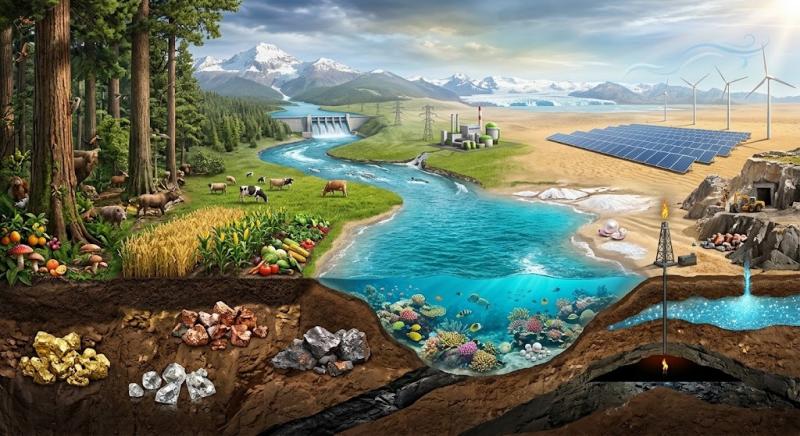
Natural resources represent one of the most significant forms of capital that countries possess. These resources, including oil, gas, coal, minerals, and forests, provide the raw materials essential for energy production, industry operations, and global trade support.
The importance of these resources increases with the ongoing demand for energy and metals used in technology and modern industries. This includes metals for batteries, renewable energy equipment, and electronic products.
Countries vary in the types of resources they have, the size of their reserves, and their economic value. According to estimates of natural resource value, Russia leads the list with approximately $75 trillion. However, these estimates are not constant indicators, as the value of resources changes with commodity prices, new discoveries, extraction costs, and available technologies.
Top 10 Countries with Natural Wealth
Below is a list based on the estimated total value of natural resources, not solely on oil reserves. Thus, the rankings might vary if a different criterion is used, such as confirmed oil reserves or the contribution of natural resources to GDP.
Russia
Russia tops the list of countries with the most abundant natural resources, valued at approximately $75 trillion.
A significant portion of this wealth is associated with its vast geographic areas containing large quantities of oil, gas, coal, timber, gold, and various metals. Russia also has important reserves of rare metals, increasing in significance in modern industries.
This diversity provides a broad base in energy, mining, and industries related to natural resources. Estimates indicate that energy, metals, and forestry represent the largest parts of its natural wealth.
United States
The United States is second, with an estimated valuation of about $45 trillion in natural resources.
It features significant diversity in resources, including coal, timber, natural gas, oil, gold, and copper, along with expansive agricultural land and forests.
The U.S.'s importance is not only in resource volume but also in its large industrial and technological capability to extract and transform them into value-added products. Hence, it holds a strong presence in energy, mining, and industry sectors.
Frequent estimates highlight coal, timber, natural gas, gold, and copper as the main resources contributing to its natural wealth.
Saudi Arabia
Saudi Arabia ranks third globally with a valuation at approximately $34.4 trillion.
Oil is its foremost natural resource, along with natural gas, phosphates, and others. The massive oil reserves are a critical source of the kingdom's economic power, making the energy sector a key element in its foreign trade.
In recent years, Saudi Arabia has been working to diversify its economy and develop new sectors. However, natural resources, especially energy, remain a vital part of its global economic standing.
Canada
Canada stands fourth, with natural wealth estimated at about $33.2 trillion.
The country enjoys exceptional diversity in resources, including oil sands, natural gas, uranium, timber, and phosphates, along with a wide range of metals.
Canada also holds vast forest areas and water resources, along with a strong foundation in mining and energy, contributing to its status as a leading producer and exporter of raw materials in global markets.
Iran
Iran ranks fifth, with an estimated value reaching $27.3 trillion.
Oil and natural gas form the largest part of its natural wealth, boasting substantial reserves of both, alongside a variety of mineral resources.
These reserves grant Iran an important position in global energy markets, although its ability to fully benefit from its resources is impacted by sanctions and trade restrictions.
Democratic Republic of the Congo
The Democratic Republic of the Congo is rich in mineral resources, often appearing at the forefront in assessments that include potential values of untapped mineral wealth.
The country is famous for its reserves of cobalt, copper, diamonds, tantalum, and gold, metals that are increasingly important for modern industries, especially batteries and electronics.
Some estimates point to significant values of unexploited mineral resources, though these figures vary greatly depending on evaluation methods and whether they account for potential or economically recoverable reserves.
China
China's natural wealth is valued at approximately $23 trillion based on total resource value rankings.
China is a leading nation globally in coal reserves and production and possesses significant rare metals, along with timber, gold, aluminum, oil, and natural gas.
Rare metals are of special importance due to their use in technology sectors, renewable energy, electric vehicles, and electronics, granting China major significance in global supply chains.
Brazil
Brazil ranks among the largest nations in terms of natural resource wealth, with an estimated value of around $21.8 trillion.
The country boasts diverse resources, including iron ore, gold, uranium, oil, and timber, in addition to vast forest and agricultural lands.
Water resources and forests form a crucial part of Brazil's natural wealth, while mining, energy, and agriculture are key sectors related to these resources. Brazil's rich natural and environmental diversity grants its resources both economic and ecological significance.
Australia
Australia's natural resources are valued at approximately $19.9 trillion, placing it eighth globally by this measure.
The country is rich in iron ore, coal, copper, gold, uranium, nickel, and rare earth elements, among other resources.
Australia is a major player in the mining sector, with mineral and energy exports forming a significant part of its economy and trade relations. The abundance of mineral resources grants the country a critical position in global markets, particularly with increasing demand for clean energy metals.
Iraq
Iraq's natural wealth is estimated at around $15.9 trillion, with oil as the leading resource.
The country possesses substantial reserves of oil, along with natural gas, phosphates, and sulfur, where oil resources are a fundamental part of its economy and exports.
Iraq also contains agricultural land, groundwater, and mineral resources, but oil remains the most economically valuable resource.
Venezuela
Venezuela concludes the top ten list with an estimated valuation of approximately $14.3 trillion.
Oil constitutes the largest portion of its natural wealth, alongside natural gas, iron ore, gold, bauxite, and diamonds.
Venezuela has massive oil reserves and recent data shows the country leading globally in confirmed oil reserves, ahead of Saudi Arabia and Iran.
Nevertheless, having large reserves does not necessarily lead to equivalent economic prosperity, given that economic, political, and productive factors affect the country's capacity to exploit its resources.
Which Country Has the Largest Oil Reserves?
If the focus is solely on oil, the rankings change compared to total natural resource wealth.
Data from 2026 places Venezuela at the top with confirmed reserves of about 303.8 billion barrels, followed by Saudi Arabia with approximately 258.6 billion barrels, Iran with about 208.6 billion barrels, Canada with approximately 170.3 billion barrels, and Iraq with about 145 billion barrels.
This illustrates the importance of determining the criteria when discussing the wealthiest countries in natural resources, as a country could have massive oil reserves without being the leader in total value of all its natural resources.
Countries Leading in Metal Ownership
A group of countries stand out for their massive metal wealth, including China, Australia, Brazil, Russia, and the Democratic Republic of the Congo.
The Democratic Republic of the Congo is particularly noted for cobalt, copper, tantalum, and diamonds, while Australia holds important reserves of iron, gold, uranium, copper, and lithium. China is a major player in rare metals, elements increasingly crucial in electronics and renewable energy industries.
Does Owning Natural Resources Make a Country Wealthy?
Not necessarily.
A country might have substantial reserves of oil, gas, or metals, but this does not automatically ensure high income levels or development for its citizens.
World Bank data shows that natural resource revenue is measured separately from just the size of reserves, including revenues from oil, gas, coal, metals, and forests. The World Bank defines natural resource rent as the difference between the value of a resource and its production or extraction cost, a different indicator from the overall value of reserves in the ground.
Over-reliance on resources can increase an economy's exposure to global commodity price fluctuations. Thus, effective benefits from these resources depend on economic management, infrastructure investment, education, industry, and income diversification.
See Also:
Top 10 Largest Cities by Population