


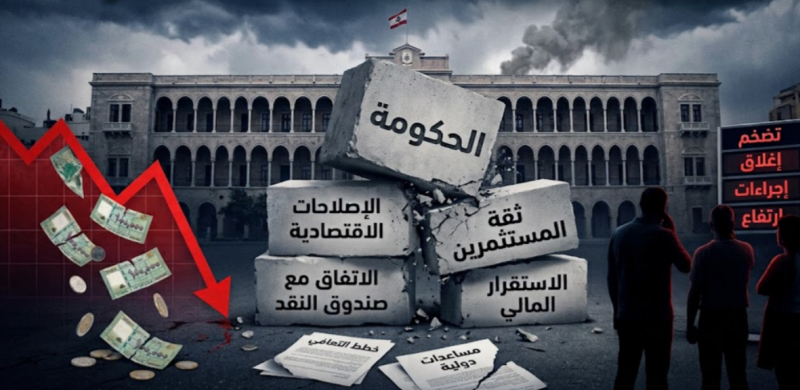
Confidence motions against Judge Nawaf Salam's government, votes of no-confidence against certain ministers, and the potential toppling of the government have become hot topics circulating in political corridors and across media platforms. This comes on the eve of the 'government discussion session' called by Speaker of the Parliament Nabih Berri, set to take place over the next two days.
Such predictions, if realized, could have 'catastrophic' repercussions on the fragile economic and financial state, already reeling from the collapse of 2019. This situation is exacerbated by the ongoing war in the south, encumbered by escalating Israeli threats of a full-scale war unless Hezbollah disarms, amidst stalled Lebanese-Israeli negotiations.
What will be the outcomes if the government or its ministers lose confidence, or if it's dissolved?
Economics expert Professor Jassem Ajaka reveals to 'Al Markazia' the repercussions of such a move on the financial and economic fronts. He states: One of the primary consequences of a no-confidence vote in the government is its transition to a caretaker status, severely limiting its decision-making capabilities in policy matters. This paralysis would disrupt the financial reform mechanism, causing a structural shock that impacts fiscal, monetary, and foreign policies.
These consequences are detailed as follows:
Monetary Policy: A caretaker government would be unable to implement macroprudential policies, leaving it powerless over the central bank. The lack of political backing would hinder coordination of macroprudential strategies with the central bank. This transition to a caretaker government will likely bring about significant political risks, leading to an outflow of foreign capital, widening the gap between official and unofficial transaction rates. The Lebanese pound would face immediate pressure to depreciate, compounded by liquidity shortages in the market.
Furthermore, due to lost confidence and resultant operational incapacity, commercial banks would be forced to hold higher cash reserves as guarantees for external trade operations, fostering greater economic instability.
Fiscal Policy: The limited authority of a caretaker government over fiscal policy would prevent the Ministry of Finance from presenting and passing a new budget bill or introducing financial measures to increase state revenues. Expenditures would follow previously approved budget patterns; thus, public sector wages and financial subsidies would be disbursed under the 'twelfths rule.' This practice would hasten real value expenditure growth and escalate fiscal pressures amid rising inflation rates.
Foreign Policy Freeze: Without authority to enforce conditions of the International Monetary Fund's Extended Fund Facility, the caretaker government could neither sign a final agreement with the IMF nor fulfill pre-borrowing conditions. It would lack the power to implement plans addressing banking sector losses or unify exchange rates under legal statutes. Additionally, it wouldn't have the mandate to reform banking laws and financial secrecy in alignment with international standards, damaging Lebanon's sovereign credit rating and preventing long-term debt commitments. External entities (multilateral) would be unable to lend to the government due to unmet conditions in the Extended Fund Facility agreement with the IMF.
Private Sector Contraction: The shift to a caretaker government would stagnate the private sector, stifling new investments. Consequently, foreign capital previously invested in Lebanon would no longer support growth and development. Moreover, with diminished trust and credibility, local companies would struggle to form or maintain partnerships with banks and international financial institutions. Heightened concerns from foreign banks over revenue absence and repayment capabilities would further reduce their financing, while the lack of coordination between the central bank and commercial banks on trade financing and confirmed letters of credit would erode existing relationships. Ultimately, this would lead to reduced cash financing, further expanding the informal economy's scope.