


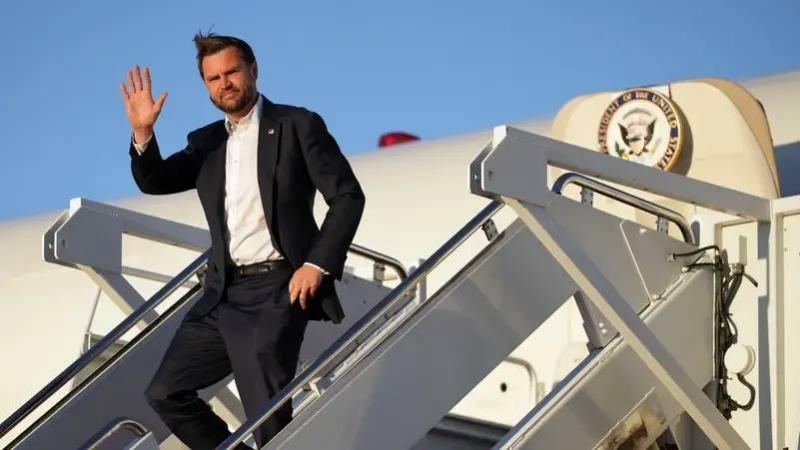
U.S. Vice President J.D. Vance has announced that the Iran war will enter a 'completely different phase in two months', aligning with President Donald Trump's anticipation that the conflict 'may end directly' after the congressional midterm elections. This comes after several months of exchanges between Washington and Tehran.
Vance noted that the Iranian regime would continue losing its grip over the Strait of Hormuz until the elections, highlighting that shipping activity through the strategic passage has 'exceeded more than 50% of its normal levels,' according to his interview with the New York Post conducted aboard Air Force Two.
He stated, 'We can't predict the future, but I think the president is correct in stating that things will shift dramatically in the coming months. As Commander-in-Chief, he determines the beginning and end of conflicts.' He added, 'I understand some impatience among the American public, but currently, the United States is not engaging in offensive operations. We are not doing that.'
Furthermore, Vance mentioned, 'What’s happening is that Iranians occasionally fire at commercial vessels, and these attacks usually fail.'
First Phase of the War 'Ends'
Vance explained that the war has undergone two phases, with the first concluding after targeting Iran's nuclear program and conventional military capabilities as well as weakening its external influence. The second phase focuses on preventing Iran from rebuilding these capabilities and maintaining as much global stability as possible.
Vance was instrumental in a memorandum of understanding between the U.S. and Iran in mid-June, facilitating a ceasefire aimed at negotiations over Iran's nuclear program and ending the conflict, although recent mutual strikes shattered it.
It's still uncertain whether Trump will escalate attacks post-midterms to finalize the mission or if Tehran will show more willingness to reach an agreement. Trump remarked to reporters last Wednesday before his departure to the Republican midterm election conference in Dallas, 'I believe the war will immediately conclude after the elections because they can't endure any further.'
Hormuz Navigation
U.S. Navy forces have conducted mine-clearing operations in large sections of the Strait of Hormuz over the past four months, yet the traffic remains significantly below pre-war levels. According to ship tracking data, only 11 commercial ships traversed the strait in the past 24 hours, compared to a pre-war average of about 130 ships navigating the waterway between Oman and Iran.
Conversely, the U.S. has secretly escorted commercial oil tankers through the strait for months, turning off their transmitters to avoid Iranian attacks, in operations described as 'dark missions' that are not evident in publicly available navigation numbers. Approximately 20% of the world's seaborne oil passes through the Strait of Hormuz.
The U.S. has significantly weakened most of Iran's missile and drone capabilities, but Tehran continues to sporadically attack commercial ships in the strait, as well as launch strikes on U.S. military bases in the Middle East.