


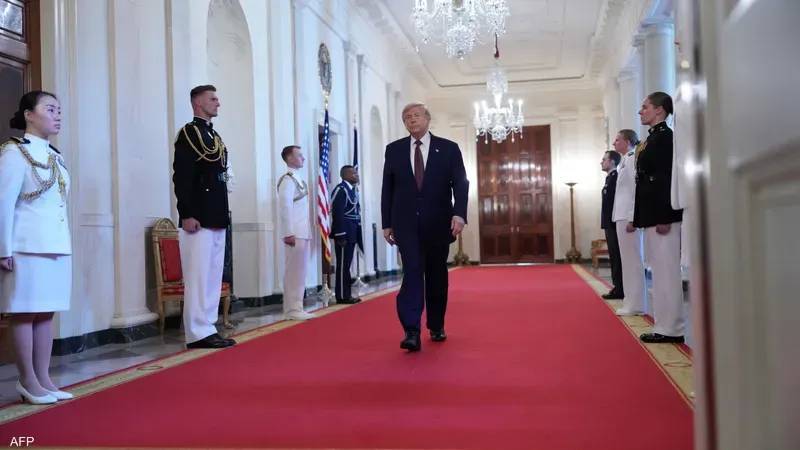
In a candid television interview, former U.S. President Donald Trump revealed that his grasp on power seemed limitless after he initiated conflict with Iran.
During his forthcoming 45-minute interview on "The Axios Show," Trump repeatedly equated power with the level of submission to him, sharing that G7 leaders took him seriously when he jokingly declared, "I am the president."
In the soon-to-be-released book "Changing the System" by Maggie Haberman and Jonathan Swan of The New York Times, Trump takes pride in a document that argues he wields more power than Attila the Hun, Genghis Khan, Napoleon, Stalin, Mao, and Hitler.
The authors note that Trump "began reading from it," listing some of history's most influential figures and explaining how each was "less powerful than him as President of the United States."
Trump remarked on leaders like Alexander the Great, the Caesars, and William the Conqueror, saying, "They didn't have planes, right? They couldn't travel or move around," with the authors mentioning his evident pleasure in referencing Napoleon.
Haberman and Swan highlight the remarkable "glee he felt in placing himself alongside Mao, Hitler, and Stalin," and the "ease with which he accepted a place among men who reshaped the world through conquest and fear."
In his Axios interview, Trump admired Chinese President Xi Jinping and Indian Prime Minister Narendra Modi, describing Xi as "entirely business-focused" and Modi as "a very strong person."
He declined to name the leaders he considered weakest, before lamenting the exclusion of Vladimir Putin from the G7, formerly G8 before Russia was expelled over Crimea's annexation in 2014.
Trump also discussed French President Emmanuel Macron's gesture of hosting him at a Versailles dinner, a spectacle he admitted was his "weak spot."
He told Axios, "Israel wouldn't exist today without me," while describing his relationship with Prime Minister Benjamin Netanyahu as "good, but needing some restraint on his part."
When questioned why the deal didn't meet his original demands, Trump clung to his version of events, asserting that the outcome was indeed an "unconditional surrender" by Iran, and a "regime change."
Trump acknowledged one remaining force that constrained him: the economy.
He pointed out that escalating the war to appease hardliners could cause a "global depression."
He referenced falling oil prices and a rising stock market as proof of his decision to back a deal potentially ending the conflict with Iran.
Trump added, "I have one fundamental wish as president... I never want to become the late great Herbert Hoover," referring to the 31st U.S. President forever associated with the Great Depression.
In the document's conclusion, Trump's readiness to employ his power on a global scale "makes him, by far, the most powerful person to have ever walked this planet."