


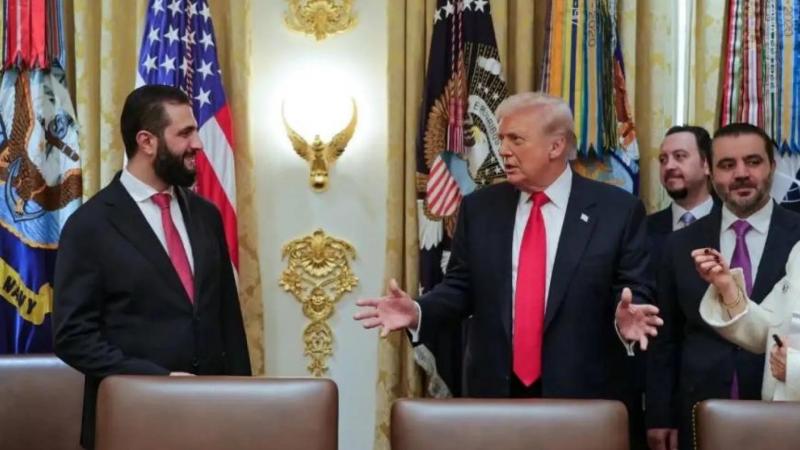
President Donald Trump's recent remarks, urging Syrian intervention in Lebanon against Hezbollah, have been met with refusal from Damascus, concern in Beirut, and are not taken seriously in Tel Aviv.
Syria, which has wielded influence over Lebanon since deploying its forces there in 1976, appears uninterested in revisiting such a move now. 'Our intervention would mean supporting the Lebanese state's authority,' explained Ahmed Zidan, media advisor to the Syrian president, exclusively to Al-Sharq Al-Awsat.
From Israel's perspective, Trump's suggestion is seen as a jab at Prime Minister Benjamin Netanyahu's government, which avoids large-scale attacks to prevent widespread destruction in Lebanon. In a statement, Israeli Minister of Diaspora Affairs, Amichai Shikli, highlighted concerns about Syrian and Turkish influence eclipsing that of Iran in the region.
Beirut swiftly rejected any Syrian or foreign involvement regarding Hezbollah, asserting it as solely the responsibility of the Lebanese state and its institutions.
Syria Clarifies Stance on Lebanese Intervention
Damascus reiterated its lack of intention for military intervention in Lebanon, while urging Hezbollah to cease interventions in Syria, emphasising a new era since the fall of Bashar Assad. 'Supporting Lebanon's sovereignty is our perspective,' reiterated Media Advisor Ahmed Zidan.
The new Syrian approach emphasizes state authority and sovereignty across Lebanese territory, rejecting militia ideologies that once led to regional instability. Furthermore, Zidan specified a developmental approach to reinforce state and societal ties, distancing Lebanon from undesirable influences.
Israel Dismisses Syrian-Tasked Disarmament of Hezbollah
Initially taken aback by Trump's framing of Syrian involvement in Hezbollah's disarmament, Israel quickly dismissed the notion as unrealistic. Some Israeli leaders perceive Trump's remark as a political maneuver critiquing Netanyahu's prolonged conflict strategy.
Critics within Israel note the political undercurrents of Trump's comments, positioning Israeli struggles over international relations, particularly with the U.S., and hinting at future negotiations.
Lebanese Political Reactions
Lebanese officials uniformly contest any Syrian intervention. Former Deputy Speaker Elie Ferzli sees Trump's comments as tactical, not strategic, within the geopolitical landscape, underscoring Lebanese sovereignty and self-management of Hezbollah's arms issue through state institutions.
Minister of Justice Adel Nassar reaffirmed exclusive state control over disarming Hezbollah, resonating with Richard Koumjian of the Lebanese Forces, who rejected Syrian involvement, citing self-governance for resolving internal issues.
Similarly, other Lebanese political factions, such as the Kataeb Party and the National Liberal Movement, underscore the primacy of Lebanese sovereignty and authority, rejecting external intervention as a breach of national autonomy.
Trump's Call for Syrian Intervention in Lebanon Rejected by Beirut, Damascus, and Israel
Share