


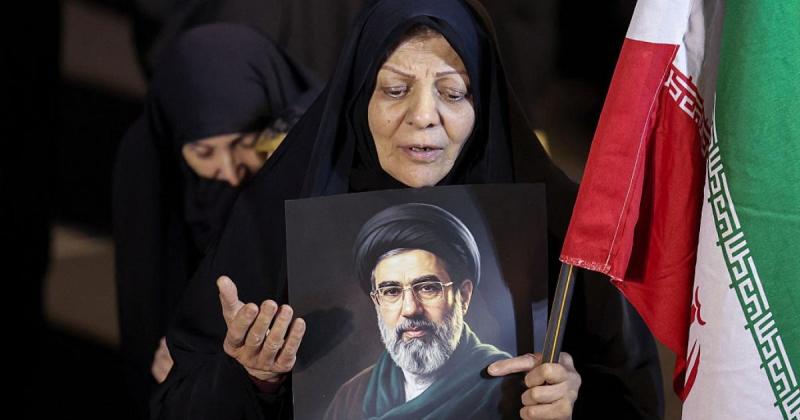
The absence of Iran's Supreme Leader Mojtaba Khamenei from the funeral of his predecessor and father, Ali Khamenei, has sparked questions about his health and concerns about possible assassination threats. It has also led to speculation regarding potential changes in the nature of the leadership position in Iran.
According to AFP, Ali Khamenei was laid to rest over 6 days in a funeral service after being killed in a joint American-Israeli strike on February 28 at the age of 86, after nearly 37 years as Iran's Supreme Leader.
The final ceremony was held in the city of Mashhad, attended by prominent Iranian political figures, including Parliamentary Speaker Mohammad Bagher Ghalibaf, Judiciary Chief Gholam-Hossein Mohseni-Eje'i, and the late Leader's eldest son, Mostafa Khamenei. However, Mojtaba Khamenei, who has succeeded his father, was absent from the ceremony.
Despite social media users' attempts to spot any appearance of the 56-year-old cleric in funeral photos, no evidence of his attendance has been found.
Since being selected as Supreme Leader shortly after his father's death, Mojtaba Khamenei has not made any public appearances, with his presence limited to written statements attributed to him.
His absence from all mourning ceremonies has raised questions about whether he was severely injured or disfigured by the strike that killed his father, as he was reportedly at his side during the attack, or whether authorities fear he could be targeted by the US or Israel.
Iranian affairs expert Farzan Sabti told AFP that “his lack of public appearance and absence even from his father’s funeral negatively impacts his image with the public, although this may be a temporary situation.”
Sabti suggested that his absence might be due to “several injuries making him unfit for public appearances,” along with security concerns that “any public appearance could be exploited for espionage or preparatory measures for his assassination.”
He also anticipated a “power struggle” between Mojtaba Khamenei and Mohammad Bagher Ghalibaf, who has become Iran’s most prominent political figure due to the conflict.
In the US, Jason Brodsky, Director of Policy at United Against Nuclear Iran, noted that Mojtaba Khamenei has become “more reliant” on the Revolutionary Guards, given his ascent to the position of Supreme Leader with their support.
Brodsky highlighted that “the power balance between the Supreme Leader's office and the Revolutionary Guards has shifted,” describing Mojtaba Khamenei as “a weaker leader” compared to his father, and reminding that it took Ali Khamenei “years” to consolidate his power after his selection in 1989 following Khomeini’s death.
He added that “as Iran attempts to show strength and unity” post-conflict, the new Supreme Leader's absence reveals that “doubt and fear prevail behind the scenes” after many officials were killed in the February 28 attack.
Meanwhile, Middle East Institute researcher Alex Vatanka pointed out that Mojtaba Khamenei “cannot match Khomeini's charisma, nor claim the power amassed by his father after a lifetime of overcoming crises.”
He added that the rejection of “inherited positions” was one of the revolution's drivers that toppled the Shah in 1979.
Mystery Surrounds Mojtaba's Absence from Father's Funeral
Share