


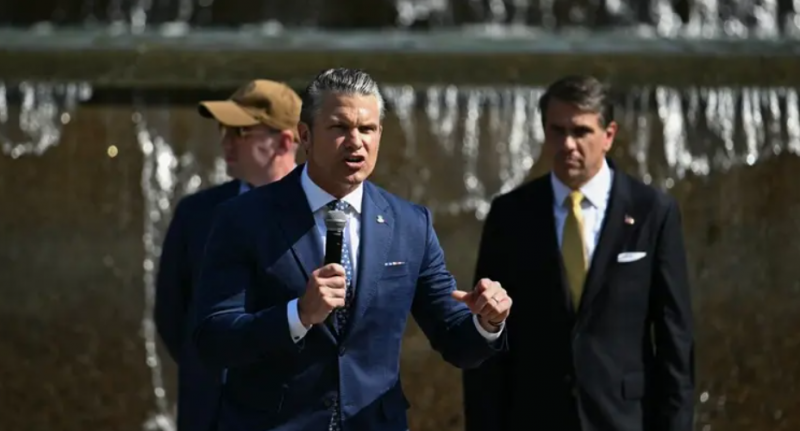
US Defense Secretary Pete Hegseth has escalated his rhetoric towards Iran, declaring that Tehran "made a wrong choice and will pay the price," following the US Central Command's announcement of the conclusion of the third round of airstrikes targeting Iranian military sites in response to attacks on commercial ships in the Strait of Hormuz.
Hegseth wrote on platform 'X': "Iran made a bad choice, and now they are paying the price," attaching a brief comment with the US Central Command 'CENTCOM' announcement regarding the latest military operation, directed by US President Donald Trump.
According to the CENTCOM statement, US forces targeted approximately 140 military targets inside Iran using fighter jets, warships, and drones. The targets included missile and drone launch sites, ammunition depots, communication networks, and coastal surveillance facilities, as part of Washington's efforts to undermine Iran's ability to target commercial navigation in the Strait of Hormuz.
300 Targets
Central Command added that the recent strikes brought the total number of targets bombed by US forces during three waves this week to more than 300 military targets, affirming that the operations followed the attack on the container ship 'MV GFS Galaxy' flying the Cypriot flag while transiting the strait.
Washington stated that the Iranian attack caused significant damage to the ship's engine room and led to the loss of one civilian crew member, considering the targeting of commercial ships as a direct threat to international navigation freedom.
CENTCOM confirmed that navigation in the Strait of Hormuz remains ongoing despite the escalation, noting that US forces have helped secure the passage of over 800 commercial ships and about 400 million barrels of crude oil through the vital maritime corridor since early May.
Iran's Response
In turn, Iran continued to respond to US strikes. The Revolutionary Guards announced implementing attacks targeting the US Al Udeid Air Base in Qatar, logistics support centers linked to US aircraft carriers at Duqm port in Oman, and attacks on a second ship in the Strait of Hormuz, alongside renewed missile and drone strikes on Qatar, Bahrain, Kuwait, and the UAE.
Iranian Parliament Speaker and chief negotiator Mohammad Bagher Ghalibaf also escalated his rhetoric, stating that "the era of unilateral agreements is over," adding: "We told you, fulfill your promises or pay the price."
This escalation follows US President Donald Trump's announcement of the end of the temporary memorandum of understanding with Iran, accusing Tehran of violating commitments by targeting commercial ships and closing the Strait of Hormuz, through which about a fifth of the world's oil trade passes.
As the exchanges of strikes continue and expand, fears of the region sliding into a wider conflict rise, with prospects for resuming negotiations between Washington and Tehran appearing more complex amidst both sides' firm stances and escalating military messages.