


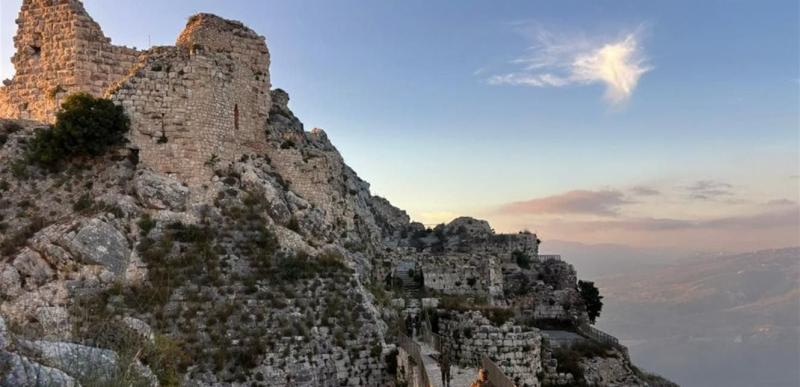
The Israeli agency "TPS-IL" has reported that, for the first time, a small group of journalists was allowed access to Beaufort Castle, also known as Qala'at ash-Shqif. This strategic fortress overlooks Southern Lebanon and Israel's northern borders.
According to the agency report translated by "Lebanon 24", Beaufort Castle, which stands 700 meters above the Litani River near Nabatieh—a Hezbollah stronghold—has been coveted by many armies over centuries. It commands views over roads through Southern Lebanon, Israeli border entry points, and a vast expanse that stretches toward Metula and the Galilee region.
Journalists were permitted to speak with Israeli soldiers from various units under the condition of anonymity in line with military protocols.
The Israeli army announced that Hezbollah has used the Beaufort height as an observation post and launched over 400 rockets and shells in March against northern Israel, particularly Metula.
While Beaufort Castle is being considered for UNESCO's World Heritage list, it was only part of what the Israeli officers wanted journalists to see. About 0.6 miles south of the fortress, the Israeli army unveiled a massive underground military complex built over the last 10 to 15 years with direct Iranian assistance. Four other similar facilities were also revealed in Southern Lebanon.
An officer from the Israeli army's elite Yahalom combat engineering unit stated that the facility served two main purposes: enabling missile attacks on Israel and providing fortified defensive positions for Hezbollah in case of an Israeli ground advancement. Sections of the tunnel network were pointed toward Metula and northern Israel.
Journalists were shown parts of the underground facility and some military equipment retrieved from the site. Israeli officers noted that most sensitive weapons had already been transferred to Israel for intelligence and technical examination.
The underground complex was designed to support Hezbollah operatives for extended periods, featuring sleeping areas, shower facilities, restrooms, and small kitchens.
It also featured a fully equipped surgical operations room maintained as sterile by Hezbollah, capable of performing underground medical interventions.
The scale and construction quality of the tunnel indicated that it was not merely a temporary wartime shelter but a permanent military facility.
According to the agency, Israeli officers stated that building this complex involved extensive excavation and controlled detonations in rocky terrains while keeping the project hidden from Israeli surveillance.
Beaufort Castle was part of a larger underground tunnel network uncovered by Israeli forces during their operations in Southern Lebanon.
The report concluded by noting that Beaufort Castle has long held a pivotal role in Southern Lebanon's military history. Israeli forces first captured it from the Palestine Liberation Organization during the First Lebanon War in 1982 and maintained a presence there until withdrawing from Southern Lebanon in May 2000.