


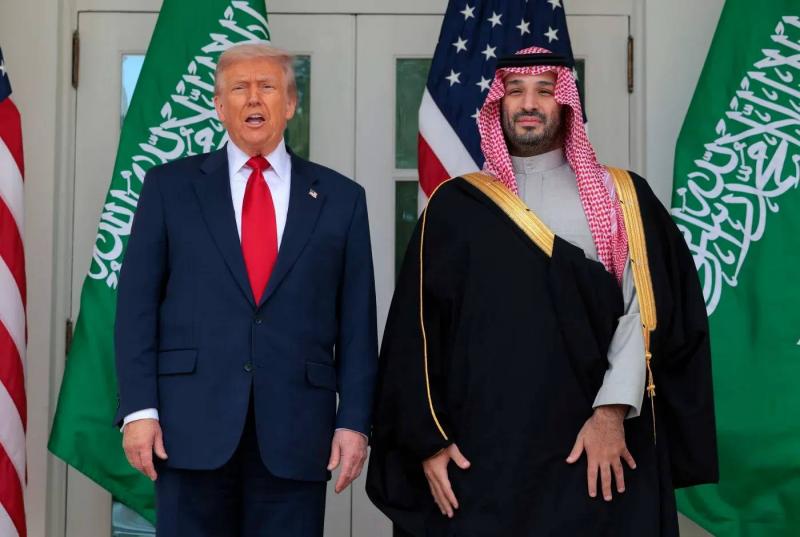
President Donald Trump has officially approved a historic 30-year civilian nuclear agreement with Saudi Arabia, potentially worth tens of billions of dollars. This deal paves the way for establishing a uranium enrichment facility in the kingdom, granting Riyadh a broad nuclear program and reshaping strategic balances in the Middle East.
According to journalists Michael Gordon and Stephen Kalin in the "Wall Street Journal," the agreement aims to give American companies a central role in developing Saudi Arabia's nuclear infrastructure while sidelining foreign competitors like Russia and China.
The agreement includes a crucial clause allowing American companies to build a uranium enrichment facility in Saudi Arabia, conditional on a joint U.S.-Saudi study deeming it necessary and feasible. Trump administration officials believe this arrangement provides Washington with direct influence over Saudi Arabia's nuclear program, preventing military use.
The deal is expected to be reviewed by Congress soon, with anticipated objections from legislators opposed to nuclear technology proliferation in the Middle East. However, blocking the deal would require a joint decision from both congressional houses and a two-thirds majority to override a potential presidential veto.
Trump gave the green light last week, with Energy Secretary Chris Wright and Saudi Energy Minister Prince Abdulaziz bin Salman set to sign it on Wednesday. Wright discussed the details during his first regional visit in April 2025.
Robert Einhorn, former U.S. State Department official, stated the agreement "could revive the American nuclear industry, strengthen U.S.-Saudi relations, and prevent Russia and China from securing a strategic role in Saudi Arabia's nuclear program." However, he warned that without sufficient restrictions, particularly on uranium enrichment, the deal could heighten nuclear proliferation risks.
Saudi Arabia argues the agreement is vital for developing a local nuclear industry, tapping into undeveloped uranium reserves, and meeting growing energy needs to allocate more oil for export and increase revenues.
While Riyadh insists on peaceful intentions for its program, Crown Prince Mohammed bin Salman stated in 2018 that Saudi Arabia would seek nuclear weapons if Iran developed them.
Westinghouse Electric and its AP1000 reactor may be key beneficiaries of the agreement. This reactor produces about 1100 megawatts of electricity, enough for a medium-sized city or a large AI data center.
American companies are set to supply Saudi Arabia with new reactors and nuclear technology, with some foreign suppliers possibly playing secondary roles.
As the projects progress, U.S. and Saudi officials will conduct a two-year study on the feasibility of uranium enrichment in the kingdom, examining commercial viability over relying on imported fuel.
If local enrichment is justified, American companies will construct the plant under a "black box" system, preventing sensitive enrichment technology from being transferred to Riyadh.
The Trump administration asserts the U.S. role will prevent enriched uranium from military use and reprocessing spent fuel for nuclear weapons.
If the U.S. opposes proceeding after the study, Saudi Arabia won't be allowed to pursue enrichment independently or with a foreign partner for ten years.
U.S. officials believe Washington's central role ensures the program remains peaceful. However, critics warn that granting Saudi Arabia a nuclear program, particularly with enrichment or reprocessing capabilities, could spur other regional countries to follow suit.
Unlike the UAE, which committed to the "gold standard" of not enriching uranium and not reprocessing spent fuel, Saudi Arabia refused to provide a similar assurance.
Henry Sokolski, Executive Director of the Nonproliferation Policy Education Center, stated: "Where Saudi Arabia goes, so do the UAE, Turkey, and Egypt. The belief that this will end positively is an illusion."
Concerns also arise over future inspections as Saudi Arabia rejects the International Atomic Energy Agency's "Additional Protocol" for stricter oversight.
The Trump administration claims a separate agreement ensures adequate oversight of U.S.-provided sites, but critics argue these measures are insufficient for potential non-American-related nuclear activities.
Beyond nuclear issues, the deal impacts foreign policy. The Biden administration was prepared to pursue nuclear cooperation with Saudi Arabia, linking it to Saudi-Israeli normalization. However, normalization prospects dimmed after Hamas's October 2023 attack and subsequent Israeli military actions in Gaza.
While Trump continues urging Saudi Arabia and other Islamic states to join the "Abraham Accords," he does not condition Riyadh's purchase of American nuclear technology on establishing Israel relations.
The agreement comes as the White House pressures Iran to curb its nuclear program and surrender its enriched uranium stockpile.
Amid Iran-Saudi regional rivalry, critics argue the Trump administration's stance appears contradictory, demanding strict Iranian nuclear constraints while assisting Saudi Arabia to develop an advanced civilian nuclear program. Nonetheless, U.S. officials affirm there is no contradiction as long as Saudi's program has effective guarantees.
Energy Secretary Chris Wright stated: "Rest assured, these agreements uphold the highest nuclear safety and nonproliferation standards, employing world-class technology and expertise, designed in the United States."
He added: "Thanks to President Trump, the American nuclear renaissance begins, benefiting both the American and Saudi people significantly."
U.S. presidents, both Democrat and Republican, resisted Middle Eastern uranium enrichment attempts. Nonetheless, blocking the current deal remains challenging for opposing legislators.
In 2018, several Congress members demanded stricter standards for any nuclear deal with Saudi Arabia, requiring congressional approval for cooperation.
Back then, Florida Republican Senator Marco Rubio, now Trump's Secretary of State, supported this strict approach, but the bill never reached a vote.
The agreement not only grants Saudi Arabia a civilian nuclear program but also opens a strategic avenue for a regional nuclear race with far-reaching consequences beyond the kingdom's borders.
The title could emphasize "nuclear weapon" or "Middle East nuclear race."