


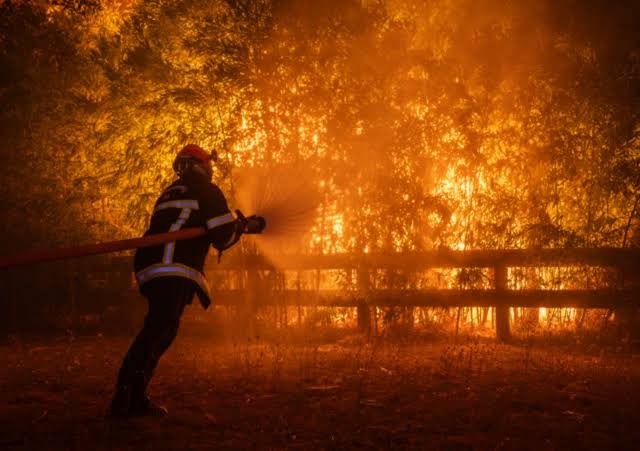
As wildfires continue to devastate vast areas of Southern Europe and North Africa, causing mass evacuations and increasing human and economic losses, the United Nations has warned that the world is facing a more dangerous climate reality. The organization emphasizes that climate-related disasters are no longer exceptional events but have become a frequent feature of a rapidly warming world.
Simon Stiell, the Executive Secretary of the United Nations Framework Convention on Climate Change, issued a stern warning, stating that the "climate alarm is sounding from every direction." He noted that climate disasters worldwide have reached levels "resembling a nightmare."
Stiell explained that "unprecedented wildfires hitting France, Spain, and other parts of Europe are forcing hundreds of thousands to leave their homes and causing severe damage to local and national economies. These fires follow extreme heatwaves that have dried up vegetation and lands," warning that forecasts of rising temperatures in the coming days could exacerbate the crisis.
He emphasized that the cost of the climate crisis, both in terms of lives and the economy, has reached a level of "national emergency" in several countries amidst increasing frequency and scope of disasters. He noted that North Africa is also experiencing exceptional climate conditions, with temperatures nearing 49 degrees Celsius, threatening residents' lives and livelihoods and putting hospitals and power grids under unprecedented stress.
The UN official added that the situation is not limited to Europe and North Africa. Chile has witnessed deadly storms that destroyed homes and claimed lives, while Japan has recorded its longest stretch of 40-degree Celsius temperatures since records began, indicating an escalation in extreme weather phenomena.
Stiell stressed that these disasters have become a reality affecting billions of people. He criticized the slow global transition away from coal, oil, and gas, along with sluggish efforts to protect forests, for accelerating the climate crisis. He affirmed that scientific evidence is conclusive, with global warming from excessive fossil fuel burning making prolonged heatwaves, violent floods, and major storms more frequent, severe, and costly.
Widespread Crisis
These remarks come as France and Spain face one of the most severe wildfire seasons in their recent history, with fires displacing more than 325,000 people from their homes or holiday accommodations. Flames have approached within 15 kilometers of the French city of Bordeaux, with authorities warning that achieving full control over the fires may take a significant time.
In southwestern France, thousands of firefighters continue to combat a massive blaze consuming an area about four times the size of Paris. The French government has deployed military reinforcements and additional resources to tackle the flames.
In Spain, firefighting efforts continue west of Madrid and in other regions, amid warnings that the upcoming heatwave and strong winds could spark new outbreaks. Prime Minister Pedro Sánchez confirmed that Spain and the Iberian Peninsula are already experiencing the direct consequences of the climate crisis.
Climate experts point out that while rising temperatures do not directly ignite fires, they create the perfect conditions for their spread by drying up vegetation and reducing soil moisture, making fires faster and more widespread, particularly with active winds.
These assessments are supported by data from the European Copernicus Climate Change Service, showing a notable increase in the intensity and duration of heatwaves in Southern Europe, lengthening the wildfire seasons and increasing their destructive capacity compared to previous decades.
The crisis is not confined to Europe; Algeria and Tunisia are also experiencing widespread wildfires amid extreme heatwaves. A strong heat dome centered over the southwestern Mediterranean and North Africa traps hot air near the ground, preventing new air masses from forming, raising day and night temperatures, and increasing the likelihood of fires and their spread.